
Start a Coffee County Search
What you already know shapes where you start. The Coffee County Public GIS/CAMA search accepts an owner, a physical address, or a segmented parcel number. It returns a tax-roll record with the parcel identity, owner field, land and building values, acreage, tax district, subdivision, deed reference, and tax history. Harvest exact spellings and numbers from that result. Remember that the CAMA record is an assessment source, not the full title chain.
Next, set the parcel card beside the newest instrument in the Probate land index, because a deed may have been recorded after the tax roll's effective date. Maps can help you locate the tract. The polygon is still not a survey. Court dockets and tax-sale records are separate again. Keep each source's date beside each fact. That habit lets you explain conflicts instead of blending them.
- Search CAMA by address, owner, or parcel. Copy the displayed parcel number, deed book and page, district, and situs address.
- Open the Probate land index. Search the owner name and deed reference, then inspect later recordings under the same parties or legal description.
- Check the Revenue Commissioner source for assessment, exemptions, payment status, and any delinquency.
- Use the GIS viewer and recorded plat to compare location, lot, block, roads, and adjoining parcels.
- Ask the correct office for an image, certified copy, older book, or record that the web interface does not expose.
Coffee County Records Custodians
No single office holds every Coffee County property record. The Judge of Probate records deeds, mortgages, releases, liens, judgments, powers of attorney, and plats. The Revenue Commissioner keeps the appraisal and the tax roll. Mapping and appraisal staff handle parcel identity and valuation. Each office maintains Elba and Enterprise access points. That split is a legacy of the two recording jurisdictions the county has run since 1907.
Coffee County Judge of Probate
230-P North Court Street
Elba, AL 36323
(334) 897-2211
Coffee County Appraisal
1065 East McKinnon Street
New Brockton, AL 36351
(334) 894-6085
Coffee County Revenue Commissioner
101 South Edwards Street
Enterprise, AL 36330
(334) 347-8734
Coffee County's Two Deed Divisions
A geographic split runs through Coffee County deed records. Elba is the county seat. Enterprise became a branch court and administrative center after the county divided its eastern and western operations in 1907. The Probate Office works through both divisions, and its online instructions identify distinct book and case conventions for each. Pre-split records usually call for an Elba-first search. Later chains can still cross both offices.
The Coffee Probate Ingenuity portal runs separate land-record and probate-case searches. Searching is free. Viewing, printing, or downloading a document costs $2 per page, so a portal miss should end in a phone call or counter visit rather than a claim that no record exists. Both offices post Monday through Thursday hours, 7:00 a.m. to 5:30 p.m.
For a chain that changes divisions, record each deed's book, page, recording date, grantor, grantee, and legal description, since those references move the search backward or forward. A grantor transfers an interest. A grantee receives it.
Coffee County CAMA Search Fields
The CAMA search is unusually useful because several paths live in one system. Basic search handles the most common questions. Detailed Parcel mode adds filters for a narrower, repeatable result. Enter one strong fact first.
| Field | Format or choice | Best use |
|---|---|---|
| Owner | Begins with or contains, up to 40 characters | Surname, entity, trust, or estate variants |
| Physical address | Number and street name | Known situs address |
| Parcel | Seven segments with leading zeroes | Exact parcel match |
| District and subdivision | Named dropdown choices | Narrow a city or recorded development |
| Book, page, deed date | Detailed mode | Link a tax card to a recent deed lead |
| Value and acres | Minimum and maximum | Screen appraisal characteristics |
Coffee parcel numbers show a county prefix and seven components. Preserve spaces, punctuation, and zeroes exactly. The parcel is the tax and map unit the county assigns. It can change after a split or merger. The tax-roll owner is not always the best title lead. The latest recorded deed is stronger. The official basic search screen lays out these search choices.
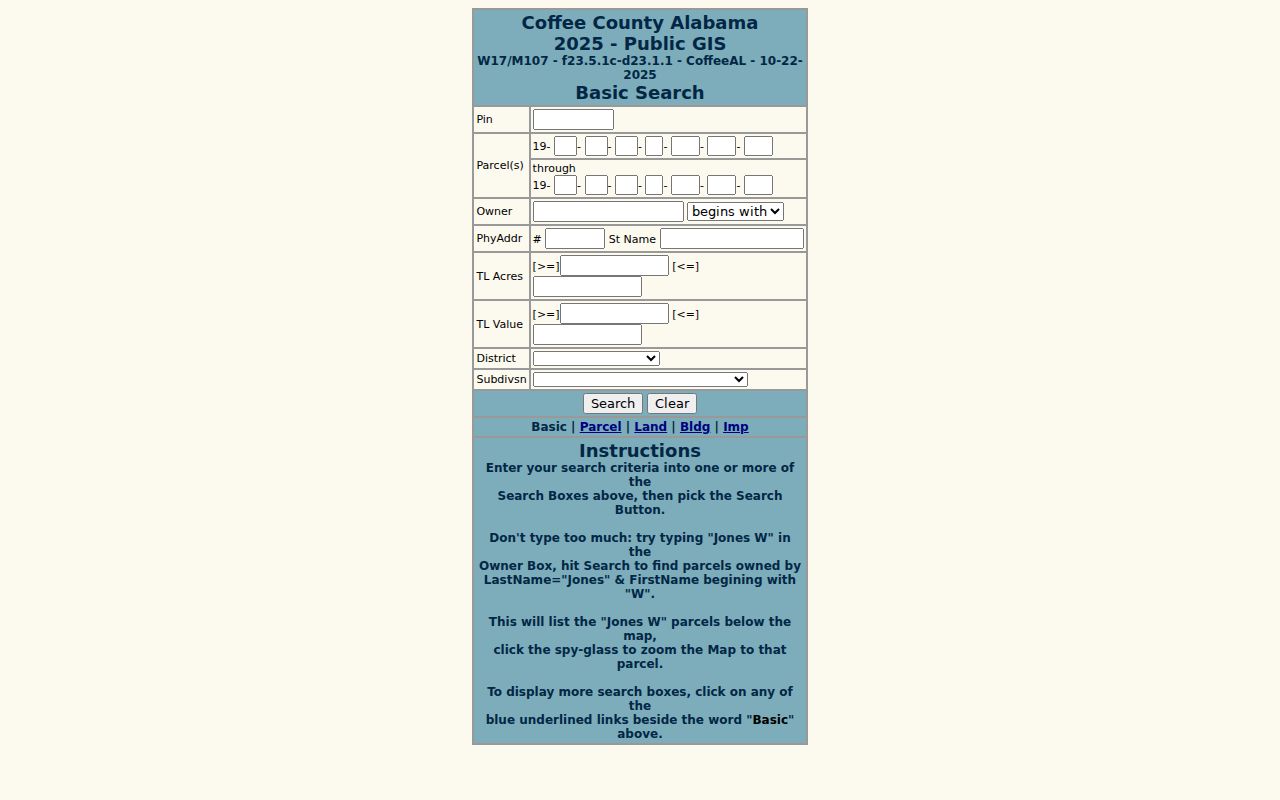
The official search form makes a small lesson plain. A short owner or street query often beats filling in every box at once.
Coffee County Property Record Types
Every record type answers a different question in Coffee County. No source should be stretched past its purpose. Deeds document recorded transfers. The tax roll ties a parcel to its assessment and billing status. Plats and GIS records add spatial context. Civil court records may reveal litigation. But a docket entry does not itself establish a transfer.
| Record Type | What It Documents | Kept By | Access |
|---|---|---|---|
| Deeds and mortgages | Transfers, security interests, parties, legal descriptions | Judge of Probate | Free index; $2 per page online image |
| Judgments and liens | Recorded claims and court-linked encumbrances | Probate and Circuit Clerk | Index, court service, or counter |
| Tax and assessment | Appraised value, class, district, exemptions, payment history | Revenue Commissioner | Free CAMA and tax portal |
| Plats and parcels | Lot, block, subdivision, acreage, mapped location | Probate, Mapping, Engineer | GIS, recorded plat, or office |
| Permits and zoning | Local approvals, land use, subdivision action | City or County Engineer | Municipal portal, packet, or request |
Pair the deed index with the parcel card first. A tax appeal starts with the appraisal and notice date. A boundary question needs the deed, the recorded plat, and a licensed survey. The GIS line alone will not settle it. The detailed Coffee County deed records route follows the recorded chain. Assessment and bill mechanics belong to the tax records.
Reading a Coffee County Card
A CAMA detail card from Coffee County is dense. It displays the parcel number, property address, deed acreage, deed book and page, deed date, neighborhood, district, owner and mailing fields, land value, building value, appraised value, yearly tax, improvement details, and payment history. Those lines are separate facts, not one story. A mailing city can differ from the situs. A deed reference is not a sale price.
- Parcel or APN
- The county's identifier for a mapped and assessed tract.
- Situs address
- The physical location assigned to the property, distinct from the owner's mailing address.
- Appraised value
- The county's fair-value estimate used before the statutory assessment ratio is applied.
- Plat
- A recorded drawing that lays out lots, blocks, streets, and related boundaries.
The inspected CAMA detail result illustrates the field layout.
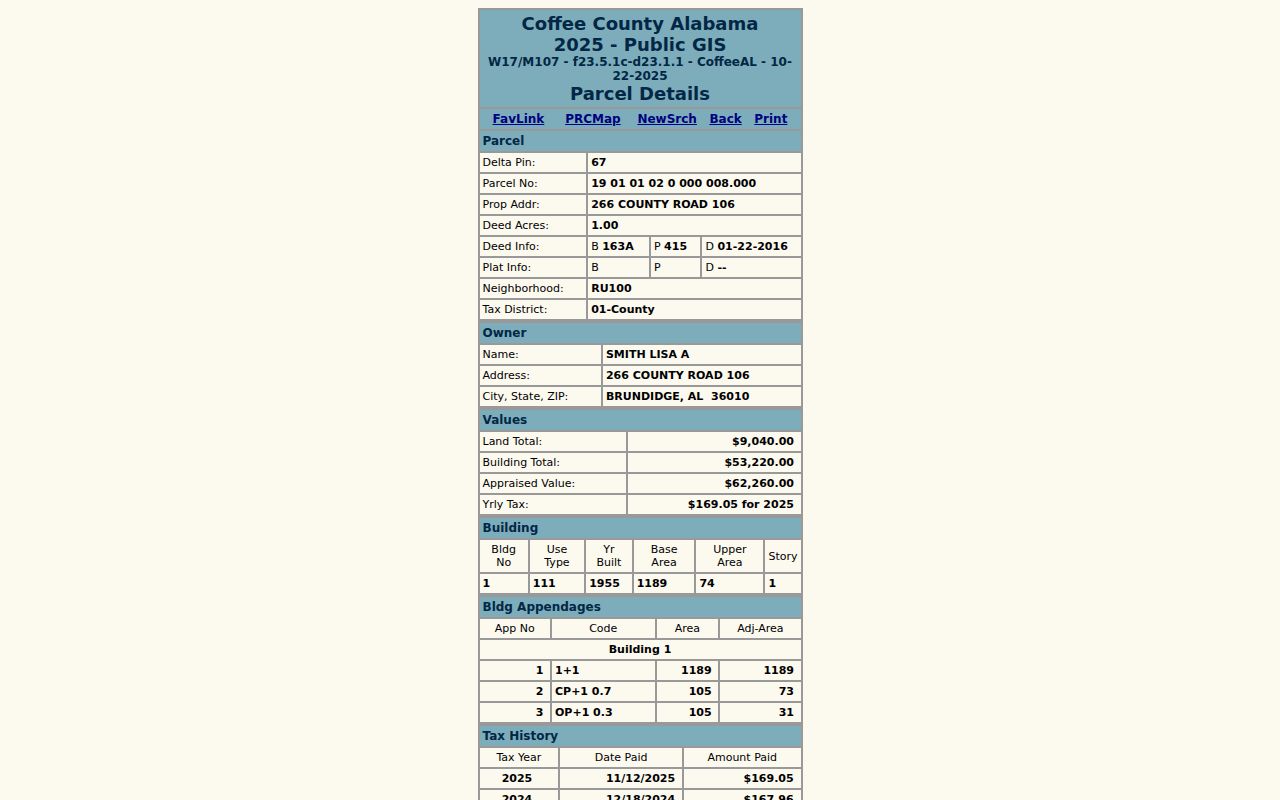
The card does pull tax, improvement, and deed-reference data together. The Probate image still governs the actual conveyance terms.
Coffee County Maps Need Context
The Coffee County GIS frameset puts three pieces side by side: a search panel and a parcel result. The Flagship map completes the trio. Aerial photography and exemption layers are among the views. Pick your parcel first. Then jot down the IDs of any adjoining polygons. Open each record on its own. Working that way keeps an owner of record from landing on the wrong shape. It keeps an appraisal there too.
Questions about the assessment map go to County Mapping. Address assignments outside corporate Enterprise belong to the County Engineer. Enterprise runs its own address contact. Elba, Kinston, and New Brockton follow the county route. A road label, mailing ZIP, city name, tax district, and municipal boundary can all disagree. Let the legal description and the recorded plat settle the match. The Flagship map frame displays the county map controls for the parcel you select.

The viewer works well as a locator and comparison tool, but its lines are reference graphics rather than a boundary opinion.
Coffee County Taxes Follow a Calendar
Coffee County property tax follows a fixed calendar. The tax year closes September 30. Taxes come due October 1, and December 31 is the last day before late fees when a payment carries a timely postmark. Delinquency starts January 1. Court notices mail in February, delinquent records run in March advertisements, and the county holds sales the first and second Mondays of April at Enterprise and Elba.
The tax roll can lag behind a transfer. Taxes are collected one year in arrears, and title for tax purposes is measured as of the prior October 1. An "In Care" notice may still carry the former owner of record, with the buyer's name appearing the next year. A new owner should record the deed, file a fresh assessment, reapply for any eligible exemption, and update the tax mailing address so the tax bill arrives correctly.
Confirm local sale timing with Revenue. The state land-sale page describes a usual first-Monday-in-May auction, which differs from the county schedule. A delinquent-tax transcript is a research lead only. It does not prove a parcel remains for sale or that redemption rights have ended.
Protect a Coffee County Name
The Probate Office offers R.E.A.A.C.t., an email alert tied to a recording name. Registration asks for name type, first, middle, and last names, plus email confirmation. Including a middle name can catch filings made with or without a middle initial, the office notes. When a deed, mortgage, lien, or other land record matches, an email goes out. It arrives within 24 hours.
Sign up through the Coffee County recording-name alert. The service provides notice, not a title determination. If an alert looks wrong, save the instrument reference and call the Probate division. Then review the actual image before acting. Never send money or personal data to an unverified caller or link.
A separate modernization agreement, approved in March 2025, targets preservation, online access, redaction, and fraud alerts for public records. That project makes careful source checks more valuable, not less.
Historic Coffee County Property Records
Fire, flood, and a two-seat system shaped the old record trail in Coffee County. The county began in 1841. The Wellborn courthouse burned in 1851. Early records were lost; not every instrument was re-recorded. An Elba courthouse burned in 1863, though most records survived. Enterprise later lost its first two courthouses. The Elba courthouse weathered major floods, including the 1929 Pea River flood.
The FamilySearch Coffee County catalog lists deeds and mortgages from 1851 through 1900. It also lists direct and indirect indexes reaching 1929. The catalog holds 18 microfilm reels made from 1979 through 1989. Those reels can hold a cleaner image than a copy damaged by later flooding. Search the direct index by grantor and the indirect index by grantee. Then pull the cited deed book. Historic land context also survives in the 1939 WPA township map. It was built from Probate records and described with property-owner lists.
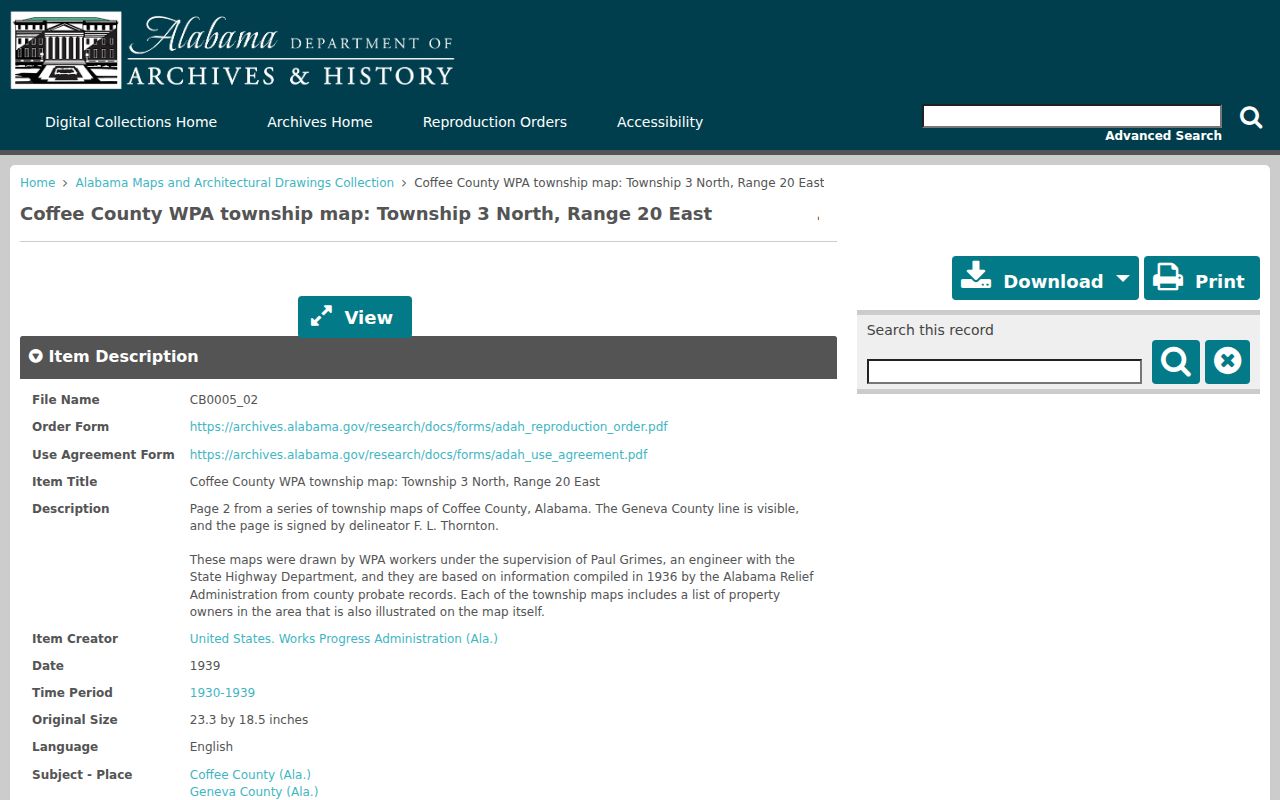
The map can corroborate an older owner or place name. It still cannot replace the deed records that define the chain of title.
Coffee County Court Record Cross-Checks
Property litigation sits with the Coffee County Circuit Clerk, not the tax roll. The county falls in Alabama's 12th Judicial Circuit. Civil files may hold foreclosure, ejectment, quiet title, partition, or mortgage enforcement. They may also hold tax appeals, boundary disputes, judgments, or construction claims. The clerk keeps court files at Enterprise and Elba. Recorded lis pendens notices, judgments, releases, and deeds also deserve a check in Probate.
Most case information routes through Alabama's paid Just One Look service. Counter access still matters. Ask by party name and case number. Then capture the filing date, action type, status, judgment, sale confirmation, dismissal, and appeal. A docket reports court activity only. It does not prove a deed was recorded or a tax account is current.
For a distressed parcel, compare CAMA, both Probate divisions, the civil docket, and Revenue records. Label every event by source. A tax sale and a mortgage foreclosure are different processes. They can even involve the same parcel.
Coffee County Request Fallbacks
Online access is only one channel for Coffee County property records. Probate handles counter inquiries and mailed originals, provided you include a return envelope. Approved vendors support electronic recording. Revenue staff answer questions by phone or in person in Elba and Enterprise. Mapping and appraisal each keep separate contacts in New Brockton. Older land and name research can draw on libraries, FamilySearch, and the Alabama Department of Archives and History.
For administrative records, the Coffee County public-records request form asks for contact details, a precise description, Alabama residency certification, and proof of residency. It directs in-person delivery to the Commission Office in New Brockton. It also notes that unsolicited electronic requests go unanswered. Spell out the department, parcel, record type, date range, and format you want. Then request a fee estimate before the office proceeds.
Alabama Code §36-12-40 guarantees the public-record right, subject to exceptions. Act 2024-278 separates standard requests from time-intensive work and sets staged response periods. Court records follow clerk and judiciary procedures. The judicial branch holds a statutory procedural exemption.
Coffee County Records and Limits
Coffee County property records can take you far. They identify the assessed parcel, the named owner on the tax roll, recorded parties, and deed references. They also cover appraised figures, the tax district, improvement data, plats, and some encumbrances or court activity. They cannot do everything. Records will not guarantee title. They will not surface every unrecorded claim. They cannot establish a surveyed boundary or predict a sale price. A blank web field may simply reflect a portal limit, a different office, older media, or a delay. It may not mean a missing record.
Official records and commercial data products are not the same thing. County sources identify the custodian, record date, and source field. Commercial summaries may blend stale material without saying when a roll changed. Start with the official record. Preserve its date. When a document must carry formal weight, request a certified copy.
Lawful use. Coffee County property records support due diligence, boundary work, tax review, history, and civic transparency. They do not replace a title professional or licensed surveyor, and owner data must never be used to stalk, harass, or harm anyone.