
Coffee County Deed Types
Probate records every instrument that touches ownership or encumbrances. A deed names the parties and describes the land. Its real effect depends on the full document and any later filings, so treat the index label as a lead rather than a title opinion.
| Deed Type | What It Does | Common Use |
|---|---|---|
| Warranty deed | Conveys an interest with stated warranties. | Ordinary purchase or transfer. |
| Quitclaim deed | Transfers whatever interest the grantor holds. | Family conveyance or title cleanup. |
| Representative deed | Transfers through estate or trust authority. | Estate administration or sale. |
| Tax or official deed | Follows a statutory tax or court process. | Distressed-title research. |
| Mortgage or release | Creates or releases a security interest. | Encumbrance research. |
Read party capacities closely. A mortgage, assignment, satisfaction, judgment, or plat can matter without changing the grantee, and the Probate recording menu lists these families of records alongside non-title filings.
Search Both Coffee Divisions
Coffee County keeps recording counters in both Elba and Enterprise. The official records page lists Elba at 230-P North Court Street, (334) 897-2211, and Enterprise at 101 South Edwards Street, (334) 347-2688. Hours run Monday through Thursday, 7:00 a.m. to 5:30 p.m. Before the 1907 split, records sat mainly in Elba. Later work may route through either division. Elba book notation adds an A after the book number, while Enterprise notation does not. Preserve that format when requesting a copy.
It helps identify the right counter and current access terms.
Coffee Grantor-Grantee Index
A grantor gives up an interest. A grantee receives one. Search both roles, because the same owner often first appears as a buyer and later as a seller, and the latest deed reference on a CAMA card or a known conveyance makes the best starting point.
- Search the current owner as grantee, using supported name variants.
- Open the deed and confirm the parcel through its legal description.
- Search that grantor as an earlier grantee for the same tract.
- Repeat backward and document each gap rather than skipping it.
- Grantor
- The party conveying the stated interest.
- Grantee
- The party receiving the stated interest.
- Chain of title
- The linked sequence of recorded transfers for the land.
- Book and page
- The location reference used to retrieve an instrument.
Start with the free Ingenuity land portal. The index finds a record, but the image supplies its terms.
Historic Coffee Deed Books
Older Coffee County deed records demand a preservation-aware search. The Wellborn courthouse burned in 1851 and destroyed early records. Re-recording was ordered, but not everything was recreated. Elba's courthouse burned again in 1863, though most records survived. Enterprise's first two courthouses also burned. The 1929 flood even reached the Elba vault. For deep history, the FamilySearch catalog identifies direct and indirect indexes covering 1820 through 1929 and deed and mortgage books from 1851 through 1900 on 18 reels. Early holdings include book B for 1851 to 1855 and books C and D for 1855 to 1858.
Historic gap. A broken chain may reflect fire, flood, incomplete re-recording, or the wrong division rather than proof that no deed existed.
Prepare Coffee Deed Filings
Recording requirements are detailed. The Probate filing rules call for the preparer's name and address, the grantor's or mortgagor's marital status, a complete legal description, signatures, notarization with stamp or seal, and the original document. A mailed return needs a large self-addressed stamped envelope. Documents go back the day after recording. An RT-1 Real Estate Sales Validation Form is also required. A grantor, grantee, owner, or agent signs it. The form asks for purchase price, actual value, or assessor market value. Check the live form layout before filing.
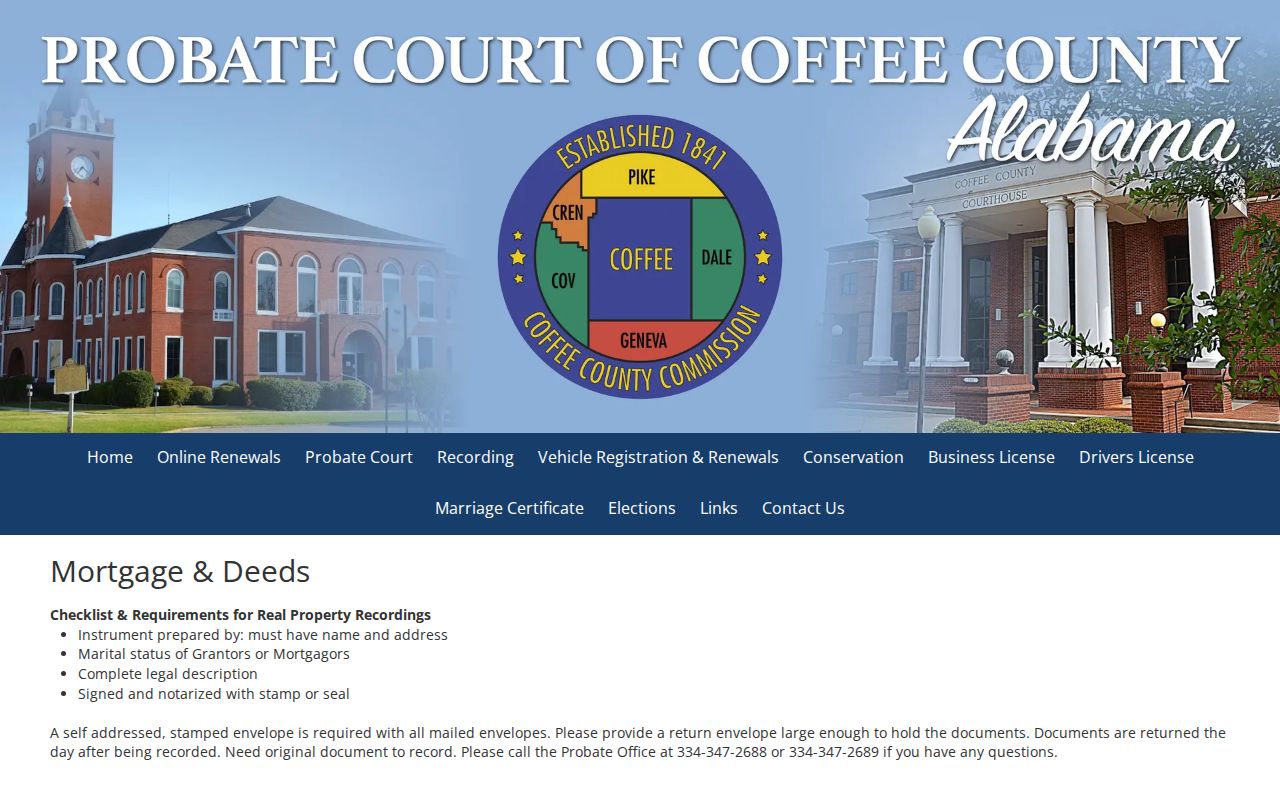
Forms and charges should be confirmed immediately before submission.
Coffee Deed Copy Costs
Land searches are free, but viewing, printing, or downloading a document costs $2 per page. An account keeps purchased records for 30 days. Search carefully before paying for a long instrument. The posted schedule sets deed tax at $0.50 per $500 of value with a $0.50 minimum, plus a $26 recording fee. Extra pages cost $3, and each grantor or grantee beyond two adds $1. Instrument types carry different charges. Confirm the current schedule before trusting any total.
Note: Confirm whether you need an index result, a plain image, a printed copy, or a certified copy before sending payment.
Monitor Coffee Recording Names
The R.E.A.A.C.T. alert takes an email and an exact recording name, with first, middle, last, full-name, and name-type fields. A matching land record triggers email within 24 hours. Deeds, mortgages, and liens all count. Notice is not title insurance or fraud proof. Review the matched image and contact Probate about any filing you do not recognize.
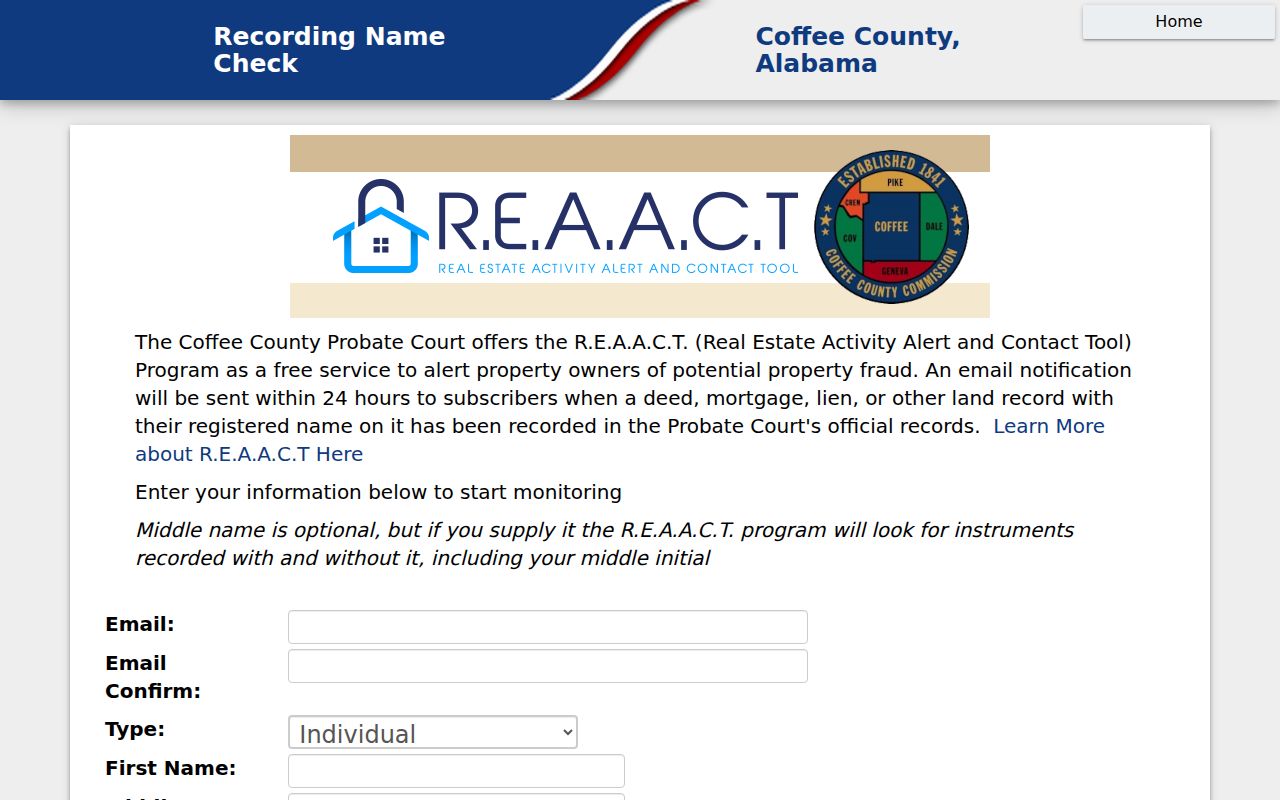
The service monitors names rather than guaranteeing the status of a parcel.
Get a Coffee County Deed
Preparation saves a trip. Gather the division, party spellings, date range, book and page, parcel number, legal description, and copy type before you call Elba or Enterprise. Approved eRecording users can file through EPN, CSC, or Simplifile and get electronic return after recording. Record execution and recording dates separately. Keep easements, rights-of-way, reservations, prior references, and attached plats. A CAMA deed reference misses many mortgages, releases, assignments, judgments, and liens, so search Probate independently.
Recorded, not guaranteed. Recording provides public notice, but it does not prove validity, clear every encumbrance, or supply a legal title opinion.
Build a Coffee Deed Packet
A deed packet holds more than a grantee name. Record the instrument type and division. Note each grantor and grantee capacity, the full legal description, acreage, consideration when stated, and the execution and recording dates. Reservations matter too. So do easements, rights-of-way, and any attached plat. When a mortgage, assignment, modification, release, or judgment matters, log its own dates and references rather than folding them into the deed record.
Check the packet against the CAMA parcel number, situs, deed-reference date, and visible roll year. Coffee County bills taxes a year in arrears and uses the preceding October 1 for tax title. Because of that lag, a tax card can still show the prior owner of record, and the latest deed can be newer than the owner field. Treat the gap as timing, then reconcile Probate, Revenue, and any court file before drawing a conclusion.
Rural tracts need extra care. Save section, township, range, and road calls. Old route names help as well. A street address can post-date the conveyance, so the complete legal description is safer than matching two records that merely share a person or a road.
Separate Coffee Court and Deed Records
Foreclosures, quiet-title suits, boundary disputes, partitions, and judgments land with the Circuit Clerk. That docket never replaces recorded deeds. A lis pendens, judgment, release, or official conveyance still belongs in Probate, so search both systems whenever litigation might touch the chain of title. Court and deed records answer different questions.
Use every identifier you have. Current and former party names come first, along with lender or trustee names, the address, APN, legal description, and any known case number. Log the filing date, action type, status, judgment, dismissal, appeal, and sale confirmation before turning to Probate for the recorded instrument behind the dispute. A filed case alone does not prove title changed.
Plan Coffee Deed Record Costs
Separate research cost from recording cost from the start. The Probate index is searchable online without an account. A chosen image costs $2 per page to view, print, or download. An account keeps purchased documents available for 30 days. Check before you buy. Confirm division, names, instrument type, book and page, and recording date. A focused index pass avoids paying for a similarly named party or an unrelated tract.
The live posted schedule carries the rest. Deed tax runs $0.50 per $500 of value, with a $0.50 minimum, plus a $26 recording charge. Additional pages cost $3. Each grantor or grantee beyond two adds $1, and the no-tax-collected stamp is $3. Mortgage tax sits separately at $0.15 per $100 of indebtedness plus its own recording charges. A mortgage satisfaction is posted at $29. An assignment or partial release runs $26. Recheck the current PDF before filing, because the schedule can change.
Name the office and division first. Add every party-name variant, a defined date range, the exact legal description or APN, and the copy type you want. Ask for a fee estimate when certification or staff work is involved. The same packet works to explain why a request belongs with Probate rather than Revenue or the Circuit Clerk.
Link Coffee Deeds and Plats
A deed can describe land many ways. Coffee County instruments may cite a subdivision, lot and block, section, township, range, or metes-and-bounds calls. Preserve that description exactly as written. When a subdivision is named, pull the recorded plat and compare its lot labels, roads, easements, and recording reference. Local development rules require a final approved plan to be recorded in Probate before lots can be leased or before manufactured or tiny homes are placed. Approval and recording dates can differ.
A blank plat field on CAMA proves little. It may mean the appraisal system lacks a link, the tract uses an older book reference, or the land was never platted as a modern subdivision. Search Probate plats, deed attachments, FamilySearch volumes, and County Engineer subdivision material before calling the record absent. Boundaries deserve better. The tax map is not the authority. For boundary reliance, the recorded description and a licensed survey carry more weight than any GIS map.