
Coffee County Tax Record Fields
Coffee tax fields come from two systems. CAMA supplies parcel values and history. Revenue confirms the current bill and delinquency, so read each field with its year and source attached.
| Field | What It Shows | Where |
|---|---|---|
| Appraised value | County estimate of market value. | CAMA card |
| Assessed value | Appraisal multiplied by the state class ratio. | Revenue assessment |
| Exemption | Approved treatment reducing taxable value. | Revenue record |
| Tax and payment | Annual amount and posted status. | Tax portal |
| District and millage | Rates tied to parcel jurisdiction. | Revenue schedule |
| Delinquency | Unpaid status and sale-process leads. | Revenue and ALDOR |
An appraisal is never a recorded sale price. A tax amount cannot prove ownership either, so use Probate deeds for title and Revenue for the live obligation.
Calculate Coffee County Property Tax
Coffee County computes tax in two steps. Appraised value times classification gives assessed value. Assessed value times millage gives the unadjusted bill. Alabama's classes set the ratio: Class I utility property at 30 percent, Class II other property at 20 percent, and Class III, covering qualifying owner-occupied homes, farm or forest land, and historic property, at 10 percent.
| Area | Posted total mills | Context |
|---|---|---|
| Unincorporated | 34 | County and school rates |
| Enterprise | 43.5 | City and school components |
| Elba | 38 | City and district components |
| New Brockton | 39 | Local city component |
| Kinston | 41 | Local city component |
Confirm the taxing district on the parcel itself. A mailing city can differ from the tax jurisdiction, and exemptions can shift the final result.
Coffee Property Tax Calendar
The Coffee County tax year ends September 30. Bills are due October 1. December 31 is the final postmark before penalties. Unpaid accounts turn delinquent on January 1, drawing one percent monthly interest, with court notices in February and March advertisements of delinquent records. Coffee holds sales the first and second Monday of April in Enterprise and Elba. State guidance describes a usually May statewide land auction. Verify the current Coffee notice and parcel status with Revenue before relying on either general schedule.
Look Up Coffee County Tax
Begin at the free CAMA search. Save the exact APN. The form accepts parcel segments, owner, address, acreage, value, district, subdivision, neighborhood, deed reference, dates, and land-description fields, so enter only enough data to isolate the parcel.
- Find the APN through the Coffee CAMA search.
- Confirm district, appraised fields, tax year, and history.
- Carry the APN to the online tax portal.
- Ask Revenue about exemptions, disputes, delinquency, redemption, or sale status.
- Assessed value
- The taxable share after applying the class ratio.
- Millage
- The rate per thousand dollars of assessed value.
- Homestead exemption
- Approved relief for a qualifying primary home.
- Tax lien
- A legal claim arising from unpaid property tax.
The Coffee Revenue page gives the official calendar, payment choices, and contacts.
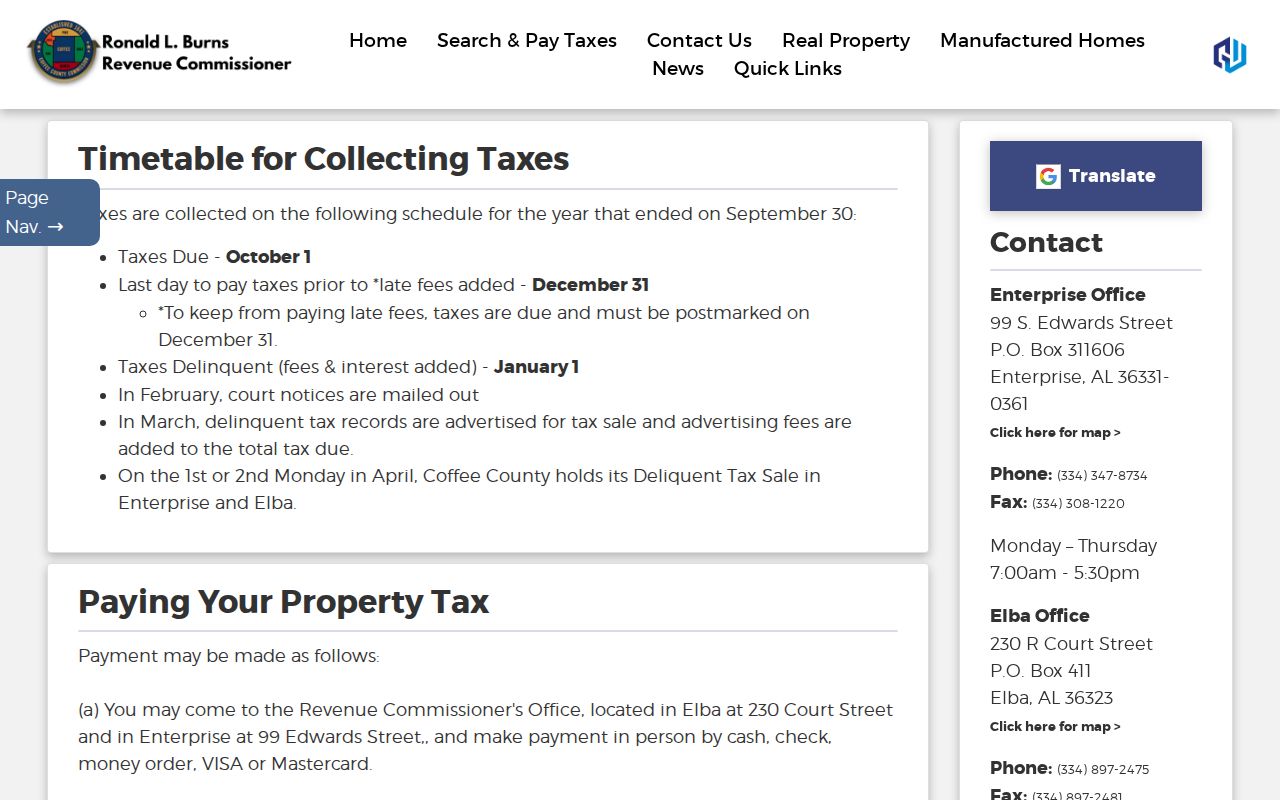
The captured page is a routing aid; check the live source for changes.
Pay Coffee County Property Tax
Payments differ by channel. Bring cash, a check, or a money order. You can also pay with Visa or MasterCard in person. Online, the Revenue office takes card, debit, e-check, and PayPal. A convenience fee of 2.5 percent or $1.50 applies to online transactions. The county does not collect that fee. Check your total before you submit.
Two offices handle payments. Enterprise Revenue sits at 99 South Edwards Street, (334) 347-8734. Elba Revenue is at 230 R Court Street, (334) 897-2475. Both locations keep Monday through Thursday hours, 7:00 a.m. to 5:30 p.m.
Coffee Property Tax Exemptions
Regular homestead treatment covers a qualifying owner-occupied single-family dwelling and up to 160 acres serving as the primary residence on October 1. Apply at the courthouse. The state exemption table controls the categories. Current-use treatment may cover at least five acres of farm, pasture, or timber land producing agricultural, livestock, or wood products, and a new owner must reapply after a transfer or name change. Apply by December 31.
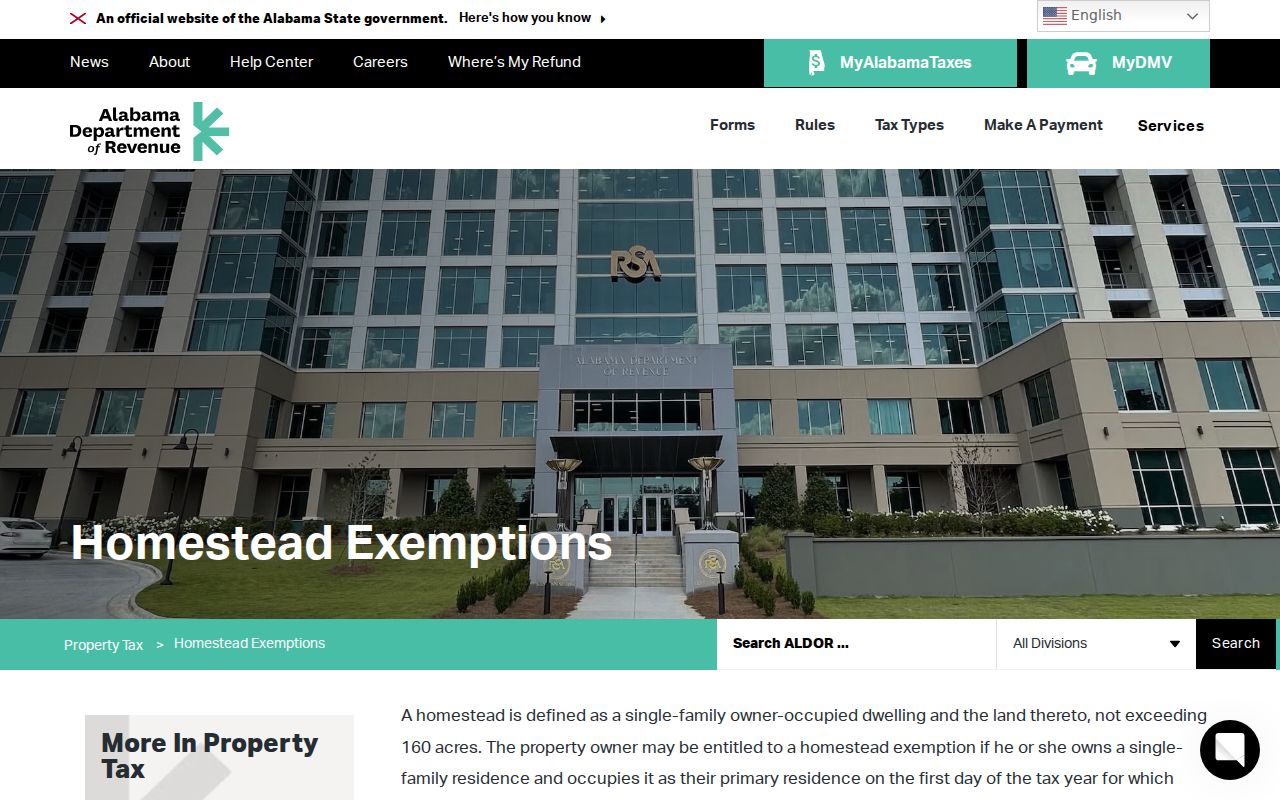
Visible ownership does not itself prove exemption eligibility.
Coffee Tax Roll Timing
Coffee County collects taxes one year in arrears. Title is set as of the prior October 1. An "In Care" notice can show a former owner. A buyer's name may not appear until the next year. The county does not prorate taxes automatically. A new owner should record the deed and file a new assessment return. The tax mailing address should be updated as well. Compare the current Probate deed with the roll date. Do not treat a tax name as final title proof.
Coffee Delinquent Tax Records
The state Coffee transcript dated November 14, 2025 lists name, year, class, parcel ID, description, and amount bid. It is a sale lead only. It cannot prove availability, delinquency, or redemption status. Confirm live status with Revenue. Then search Probate for later deeds. Tax sale and mortgage foreclosure are distinct, and a tax transcript cannot replace a redemption ledger or title search. Note: Save the tax year and search date because payment and redemption can change after a transcript is posted.
Appeal Coffee County Assessments
Check parcel identity, land and building facts, classification, district, and exemption first. Gather the current card, photographs, measurements, and sale evidence. Contact Revenue and follow its Board of Equalization procedure. Alabama Code §40-3-25 sets a 30-calendar-day appeal period after the statutory notice of a Board valuation ruling. Notice to the board secretary and circuit clerk, bond, and other steps apply. Verify the current procedure with Revenue and counsel.
Appeal window. Confirm the notice date and filing steps at once because the statutory 30-day period can be decisive.
Reconcile Coffee Tax Evidence
A transferred parcel in Coffee County carries several dates that are easy to blur together. Keep at least four distinct. These are deed execution, Probate recording, the CAMA roll or deed-reference date, and the tax year. A court filing may add yet another. Resist calling any of them the purchase date. Each office records a different event. A newer entry in one system never quietly rewrites an older entry somewhere else.
Build a tax worksheet for the parcel. Include the parcel number, physical address, mailing address, district, and property class. Add land value, building value, appraised value, assessed value, and exemption. Also list the current tax bill, payment date, delinquency status, and date checked. When a value or owner of record conflicts, record both versions. Then ask the office that owns the field. Revenue controls assessment and payment status. Probate controls recorded instruments, and GIS supplies the map context.
The discipline matters most right after a sale. Coffee County itself warns that an "In Care" tax bill can still carry the prior owner's name. An authentic current deed and an authentic older tax roll can simply have different effective dates.
Coffee Tax Sale Record Limits
A delinquent transcript or an advertised parcel is not an offer of clear land. Before any purchase or redemption analysis, get current status from Revenue. Pull the latest Probate deed and encumbrance index. Check the relevant court dockets. Obtain professional title or legal advice. Confirm whether the taxes were paid, sold, redeemed, or moved into another state process after the document date.
Tax sale and mortgage foreclosure are different animals. The first flows from unpaid ad valorem tax law. The second follows a lender's security instrument and its own foreclosure process. A tax delinquency proves nothing about a mortgage, and a foreclosure docket proves nothing about whether property taxes are current.
Never treat an amount bid as market value. A bid reflects a distressed statutory process. It may bundle taxes, interest, fees, or penalties. Keep it separate from the CAMA appraised value and from any consideration stated in a recorded deed or RT-1 form. Each number has its own purpose and effective date.
Read a Coffee Tax Card
The inspected public CAMA example shows why every figure needs a label. Its land total is $9,040. The building total is $53,220. Appraised value comes to $62,260. The 2025 yearly tax is $169.05. None of these numbers are interchangeable. The tax card also carries a district, neighborhood, acreage, building data, an owner field, a mailing line, the property address, and a deed book, page, and date.
The payment history covers 2022 through 2025. Still, that history is not a deed chain. Its deed reference leads to Probate but reveals nothing about every mortgage, assignment, release, judgment, or lien recorded against the parcel. A blank plat field does not prove that no plat exists. Treat the card as an inventory of appraisal and tax leads, then verify each fact with its actual custodian.
Building fields feed value review too. The example reports a main structure use type, construction year, base and upper areas, story count, and appendage codes. If the card conflicts with the property itself, document the issue with measurements, photographs, permits, or other reliable records. Contact Appraisal. Never swap the official tax calculation for an informal online estimate.
Check Coffee Tax Districts
The posted millage components stack up quickly. State 6.5, Coffee County 10.5, countywide schools 5, District 1 schools 12, District 48 or Enterprise schools 11, and District E or Elba schools 11. Municipal components include Enterprise 10.5, Elba 5, New Brockton 5, and Kinston 7. The right combination depends on the parcel's actual tax district.
Never pick a total from the mailing city alone. A Coffee County property can carry a postal label that differs from its municipal status or tax district. Save the district displayed in CAMA. Confirm it with Revenue. For an edge parcel, compare the GIS location, the legal description, municipal boundary evidence, and the current tax record before calculating an expected bill.
Write out any bill estimate in separate lines. List appraised value, class ratio, assessed value, each applicable millage component, exemption adjustment, and the resulting figure. Then compare the estimate against the actual Revenue bill. A difference can stem from an exemption, a class, a district, a delinquent charge, or a value effective in another year. Never overwrite the official amount with the estimate. Ask Revenue which field explains the difference, and keep the response date with the worksheet.