
Coffee County Ownership Checks Beyond the Web
A failed online lookup proves nothing. Missing results are not missing records. The Probate Office keeps counters in both Elba and Enterprise. Its online-record page explains how each one works. Staff at either counter can sort out a division, a book prefix, or an unclear image. Searching is free. Downloaded or printed pages carry posted charges. Call before you drive over. Bring the full parcel number, legal description, every name variant, a date range, and the CAMA deed reference. With those keys, the clerk retrieves a specific instrument. That beats a vague file tied to an address.
Older ownership leads live elsewhere. FamilySearch catalogs Coffee County direct and indirect deed indexes. It also lists deed books and eighteen microfilm reels filmed between 1979 and 1989. The Alabama Department of Archives and History offers research-room collections and a 1939 WPA township map listing owners. The Enterprise and Elba libraries hold newspapers and local-history material. Treat any archival name as a lead only. Follow it through each later grantor-grantee transfer. The chain should reach the newest deed and the current parcel card. The 1851 and 1863 fires, the 1907 division, and the 1929 flood may explain a gap. None of them justifies inventing a missing link.
Identify Who Owns a Coffee County Property
Ownership in Coffee County comes into focus at four checkpoints. Each narrows the answer instead of asking a general directory to guess at title.
- Enter the physical address in the Coffee County Public GIS/CAMA search.
- Open the matching card and copy the parcel number, owner display, situs, deed book, page, and deed date.
- Search the Coffee Probate Ingenuity portal for the latest deed and its grantee.
- Match the legal description to the parcel. Ask the proper Probate division about any conflict or later instrument.
A four-step sequence names the owner on the current administrative roll and traces that name back to recorded evidence. That is a records check, not a title examination.
Coffee County Owner Evidence by Source
Coffee County divides its evidence. Appraisal, recording, mapping, entity, and litigation material sit in separate systems, so no single screen proves every part of ownership.
| Official source | What it contributes | Access route |
|---|---|---|
| Public GIS/CAMA | Owner display, mailing line, parcel and deed reference | Free web search |
| Judge of Probate | Grantee, grantor, legal description and recording stamp | Free index; paid document pages |
| Flagship GIS | Selected parcel shape and map context | Free viewer |
| Secretary of State | Business entity name and filing context | State business search |
The tax roll owner is current and useful. The recorded deed still does the better job of showing the transfer and the form of vesting.
A Coffee County Parcel Card Is Not an Address Directory
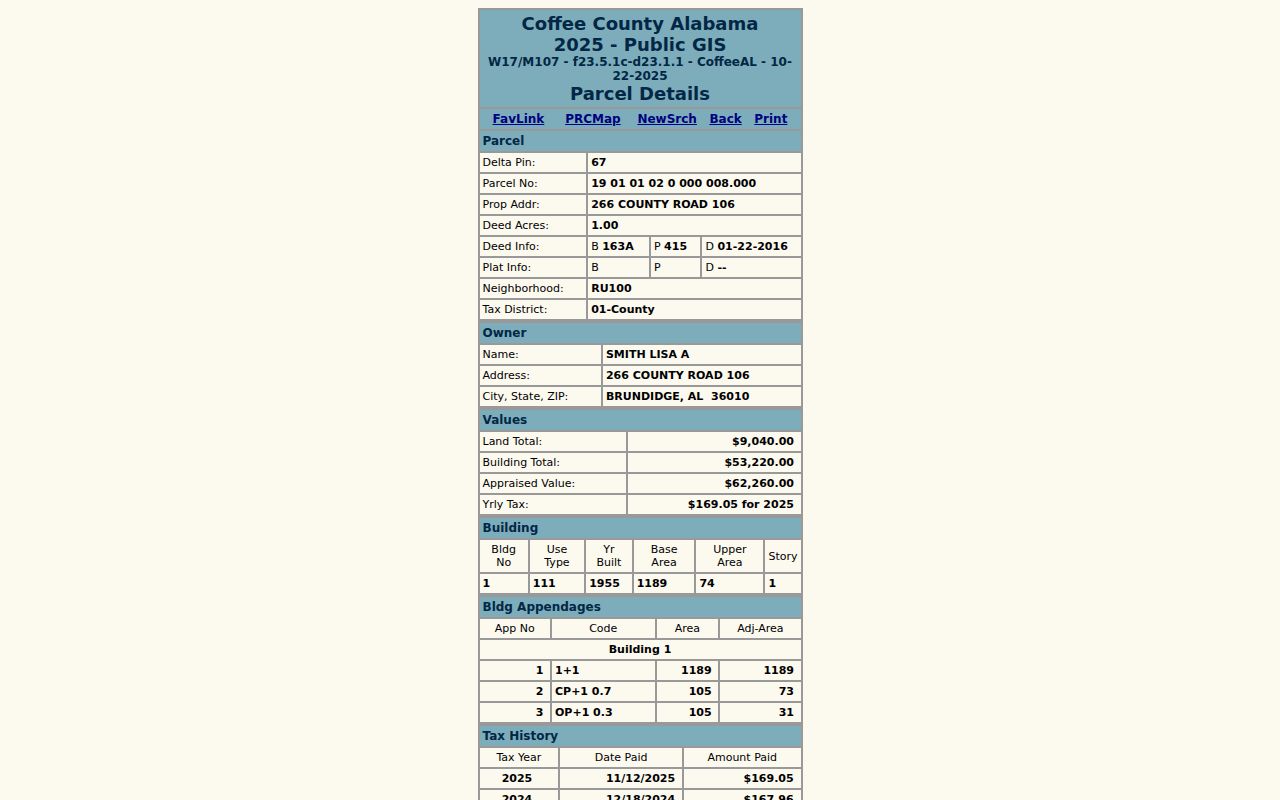
A parcel card proves less than it seems. One Coffee County sample shows a County Road 106 property address against a Brundidge mailing address, alongside acreage, value, deed data, building details, and tax history. The mailing city proves nothing about situs. It is not residence either. Nor does the tax address replace the deed's legal description, so keep the fields separate and review the official sample parcel detail before relying on any card.
LLCs, Trusts, and Estates in Coffee County Owner Records
An LLC, trust, or estate grantee changes the task. Copy the deed wording exactly. Phrases like "as trustee," "personal representative," "manager," "successor," and "nominee" carry legal capacity, and none should be stripped from the name. Search Probate first. The Alabama Secretary of State can clarify an entity name, formation, or status, but its business file does not prove later title or beneficial ownership.
Ownership terms
Vesting states how title is held. A grantee receives the deed interest. The owner of record is the name an official record carries, and situs is the parcel's location, not necessarily the tax-mailing address.
Keep Coffee County’s Four Property Dates Apart
Coffee County ownership work turns up several distinct dates. A deed has its execution date. Probate adds a recording date, the CAMA roll adds a deed-reference or roll date, and the assessment year stands apart from all of them. Litigation brings a court filing date too. These are different events. Calling one of them a purchase date can conceal a recording delay or a roll update; the CAMA example shows a deed date beside several tax-history years.
Note: The inspected interface carried a 2025 Public GIS banner and version date, so later roll changes should be checked.
Why Coffee County Has Two Probate Counters
Geography shapes a Coffee County owner search. Elba holds the primary older record setting. After the 1907 split, Enterprise became a second administrative and court center. A current instrument sits in its recording division. An older chain can require both. Probate lists Elba at 230-P North Court Street and Enterprise at 101 South Edwards Street, open Monday through Thursday from 7:00 a.m. to 5:30 p.m.
If the web index leaves the ownership question open, head to a counter. Carry the parcel number, legal description, exact name variants, date range, and book/page. A focused request beats a vague one. Asking for every record about an address invites confusion, while asking for one instrument gets an answer.
When the Coffee County Web Search Falls Short
Online searching is only one channel. The Ingenuity index allows free name searches, though viewing and printing documents cost a per-page fee under the posted Probate instructions. When no image appears, call or visit the recording counter in Elba or Enterprise. Older research can also move to the FamilySearch catalog, which lists direct and indirect Coffee County deed indexes, early deed books, and microfilm produced from 1979 through 1989. The Alabama Department of Archives and History adds a research room, a catalog, and vertical files. Its 1939 WPA township map even lists owners.
Archives can rebuild a lead. They rarely answer who owns this property today. Carry each archival name or map reference forward through every later transfer until it meets the newest deed and the current parcel. Coffee County's 1851 and 1863 courthouse fires, the 1907 division, and the 1929 flood explain why one historic chain may require more than a single index or preserved copy. Label any uncertain link as a lead. Never fill the gap silently.
R.E.A.A.C.T. Monitors a Coffee County Name
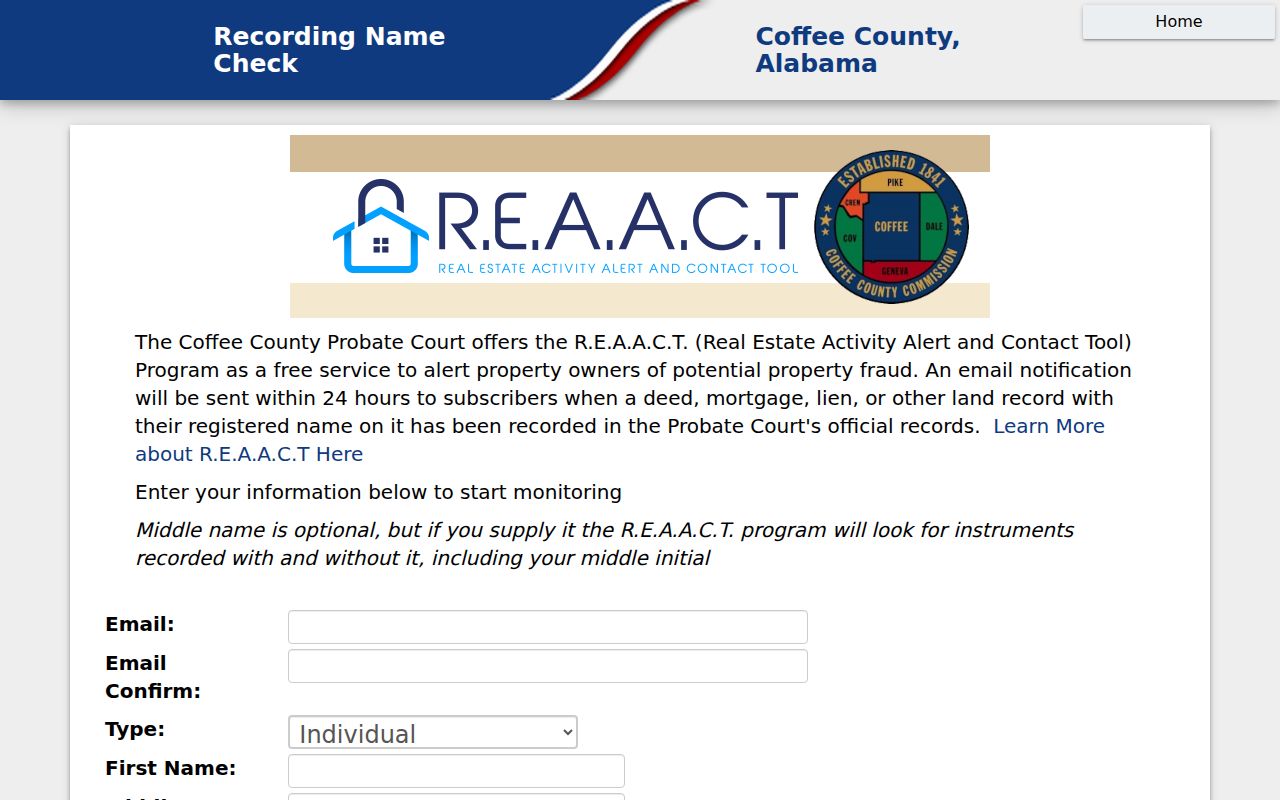
Coffee Probate's R.E.A.A.C.T. service registers one exact name as a safeguard after a search. When that name appears in a newly recorded document, the office says an email alert follows. It arrives within 24 hours. The alert cannot stop a filing or judge an instrument's validity. Register every name variant prior deeds use. The official R.E.A.A.C.T. page shows the form.
Limits on Who Owns This Property Results
An owner display never proves occupancy. The owner may get mail elsewhere. Someone sitting at the address may hold no recorded interest at all. Public screens can also lag, omit an image, or index a name differently. Court orders, estates, liens, corrections, and later deeds all shift the legal picture. For the present roll field, compare the Coffee County current owner guide.
A sound match needs more than a shared name. Compare the parcel number, legal description, acreage, tax district, subdivision, and deed reference across the CAMA card. Then do the same across the Probate instrument. Street spelling alone is weak evidence. It fails most often on a county road or near a city boundary. The County Engineer assigns addresses outside corporate Enterprise. Enterprise handles its own address work. A mailing ZIP can cross that line too. Keep the physical site, the tax mailing line, and the legal land description in separate notes.
When a deed names spouses, co-owners, trustees, or a personal representative, preserve every capacity and vesting phrase. Then search for any later correction, quitclaim, survivorship instrument, estate deed, or court order. A mortgage or lien names parties to a debt. It does not make the lender the owner. A tax payment likewise proves an account was paid, not who held title that day.
Recent transfers deserve a timing check. Coffee County measures tax title as of the preceding October 1. Bills can carry an "In Care" line or a prior owner until the next cycle. Ask Probate for the latest recording date. Ask Revenue which roll year the owner field reflects. If the sources conflict, report both dated facts rather than trusting whichever screen looks newer.
Use owner information lawfully. It supports purchase research, estate work, boundary questions, and civic review. Never use it to stalk, threaten, harass, or target anyone.