
Trace Former Coffee County Owners Backward
Begin with the newest verified deed, not a loose surname search. Open the CAMA parcel card and copy its parcel number and deed reference. Then locate that instrument in Coffee County Probate. Read every field: grantor, grantee, legal description, execution date, recording date, deed type, and any cited prior instrument. Note the grantor. Note the grantee. Note the legal description, execution date, recording date, deed type, and any cited prior instrument. The grantor is your immediate former-owner lead. That party's acquiring deed becomes the next row in the chain.
| Transfer date | Grantor to grantee | Deed type | Book/page |
|---|---|---|---|
| Newest verified | Prior owner to current grantee | As recorded | Current reference |
| Earlier verified | Next prior grantor to later grantor | Warranty, quitclaim, or other | Prior citation |
| Older verified | Earlier grantor to earlier grantee | Preserve exact label | Index or book reference |
Add no row until the instrument and its land description tie it to the same tract. A similar name alone proves nothing.
Walk the Coffee County Deed Chain
A repeatable sequence keeps earlier owners attached to the parcel even when names, addresses, or acreage shift between transfers.
- Save the CAMA APN, situs, acreage, district, and latest deed reference.
- Open that Probate deed and match its legal description to the land.
- Copy parties, capacities, deed type, both dates, and prior citation.
- Search the grantor in the direct index for their acquiring instrument.
- Match the description again and repeat to the target year or first gap.
One transfer may cover only part of a tract, or only a partial interest. So track lot and block, section-township-range, acres, adjoining owners, and any reservations or exceptions. Never assume every name in the deed records covers the whole present parcel.
Terms for Finding Previous Coffee County Owners
Index labels tell you which side of a transfer to search. They also keep a tax roll name from being mistaken for a complete title history.
Deed-chain terms
Grantor conveys an interest. Grantee receives it. A chain of title links every instrument affecting the same land. The direct index is organized by grantor, and the indirect index by grantee. A warranty deed carries stated promises about title. A quitclaim deed passes only whatever interest the grantor actually holds, without those promises.
Read the granting clause, the parties, capacity, exceptions, and the legal description. Keep the document's own wording rather than inferring its scope from the title alone.
Former Owners Across Two Probate Divisions
Coffee County split administratively in 1907. An Enterprise branch followed, and the older property records stay mostly in Elba. Begin any pre-1907 chain in Elba. A later chain may still need both divisions. A cited book, a cross-division transfer, or a historic tract will not always resolve in the first index you search.
Probate separates the book systems too. Elba records use an A with the book notation; Enterprise records do not. Copy the notation exactly. Probate cases also carry PC for Elba and PR for Enterprise. These conventions guide retrieval, but they say nothing about where the land lies today.
Historic fallback. If one online division stops the chain, search the other and ask about re-recorded, separately indexed, or microfilmed material.
The Coffee Probate Index Is Only a Lead
The Ingenuity portal allows free index searching. Its posted instructions charge $2 per page to view, print, or download a document. An index entry gives names and reference clues only. The image itself carries the legal description, capacity, reservations, and cited prior title needed for a former-owner search.
At the counter, bring the parcel number, current grantee, prior grantor, date range, a legal-description phrase, and the exact book and page. Ask what the result is: an index entry, an image, a certified copy, a plat, or a probate case. Individual instrument access is covered with Coffee County deed records. The former-owner trail links transfers across time.
How Far Back Coffee County Ownership Records Go
The FamilySearch catalog lists Coffee County deeds and mortgages from 1851 through 1900. It also holds direct and indirect indexes described as spanning 1820 through 1929. The catalog includes eighteen reels filmed between 1979 and 1989. Those holdings push property search work well past the current parcel screen. Still, image and book availability must be confirmed case by case.
Older work can reach land-office or military-warrant material. Enterprise Public Library notes such holdings for Montgomery, Sparta, and Elba. ADAH preserves county collections and maps. An archive clue joins the chain only when its parties, land description, and later transfers all connect to your parcel.
Chain Gaps After Coffee County Fires and Floods
The Wellborn courthouse burned in March 1851. Not every record ordered re-recorded was ever recreated. The Elba courthouse burned in 1863, though county history says most records survived. The 1929 Pea River flood put twelve feet of water in the vault. Early Enterprise courthouses suffered fires as well.
These events can explain a missing image or a damaged original. Some gaps forced a later re-recording. Some forced reliance on microfilm. They do not justify claiming an era's records vanished wholesale. Instead, state the last verified deed and the next missing link. Say whether the surviving evidence is an index, image, plat, map, or notice.
Start Prior-Owner Research with the Parcel Card
The official sample parcel detail shows what a Coffee County CAMA card holds: parcel number, situs, owner mailing line, acreage, value, deed date, building data, and tax history. Its fields need limits. A Brundidge mailing line on a County Road 106 parcel does not establish residence. And tax history is not deed history; the tax roll answers to the assessor. The deed chain answers to Probate.
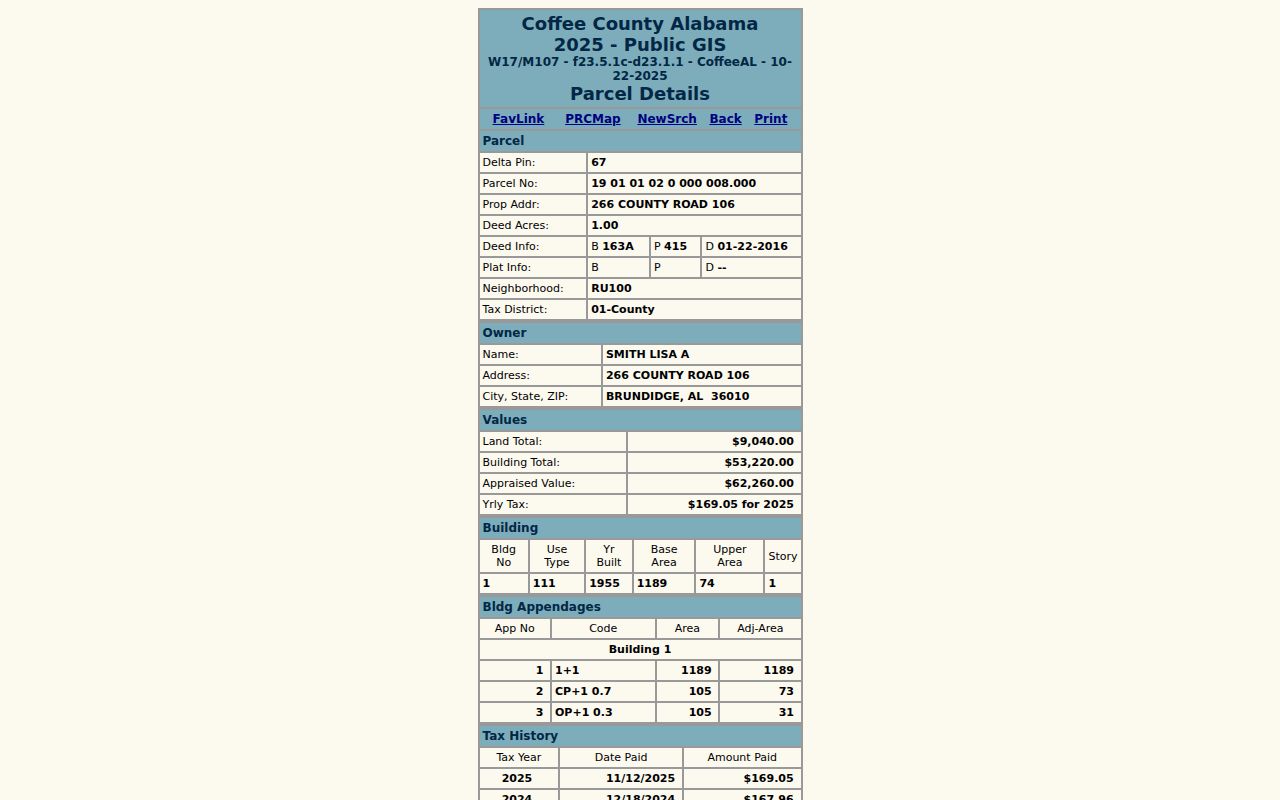
Carry the parcel number and legal description into Probate from there. Never infer a former owner from a name in an appraisal table alone.
Estate Transfers Can Break a Clean Owner Chain
Land rarely moves in a straight sale-to-sale line. In Coffee County, an estate transfer or court order can change the chain's shape. So can a trust, foreclosure, or representative deed. Keep the exact capacity terms you find: personal representative, trustee, successor, manager, nominee. That capacity is why the signer and the titled party sometimes look nothing alike.
Search the deed before anything else. Then pull the probate or court file it cites. PC and PR prefixes help route probate cases between Elba and Enterprise. A death certificate, obituary, or business filing may offer a lead. It cannot replace the order and the recorded conveyance that actually move the interest.
Historic Maps Corroborate Coffee County Owners
The 1939 WPA township map held by ADAH lists owners within each township and section. That helps place a surname on the ground. Test that location against modern GIS, recorded plats, and deed descriptions. The goal is to see whether it overlaps the current parcel. The comparison matters most where roads shifted. It also matters where a rural tract never had a stable street number. Treat the map label as corroboration only, never as a conveyance. Record the title, date, sheet, and geographic clue. Then pull deeds on both sides of the map date. A blank CAMA plat field does not mean no plat exists. Check Probate books, deed attachments, County Engineer files, FamilySearch, and area archives before giving up.
Separate Four Dates for Each Former Owner
Each former owner in Coffee County can carry four distinct dates. Record each one separately. Note the deed execution date, the Probate recording date, the CAMA deed-reference or roll date, and the tax assessment year. A probate order or judgment may add a fifth. None of these should be relabeled as the purchase date. A deed can sit signed for months before it reaches recording. The tax roll may still carry the prior owner of record long after that. Attach every date to its source and to the period it actually proves. This discipline matters for re-recorded instruments. A later recording may preserve an earlier transaction, and this habit keeps a tax-bill year from standing in as the start or end of title.
Limits of Coffee County Former Owner Findings
A backward deed chain through Coffee County property records identifies recorded parties. It also shows interests tied to one legal description. It proves nothing about occupancy, beneficial interests, or the absence of an unrecorded claim. Watch for traps. Similar names, changed acreage, corrective deeds, life estates, and partial transfers all create false links. Descriptions get ignored when that happens. When the chain hits an unsupported link, stop there. Label the gap and name the next repository worth checking. That approach beats inventing a former owner from a surname match.
Lawful use. Deed history supports title diligence, estate work, preservation, boundaries, and civic review. Never use owner data to stalk, harass, threaten, or harm anyone.