
Build a Dated Coffee County Value Comparison
A sound comparison takes more than three dollar amounts. Build one row per source. Capture the parcel number, value label, effective year, classification, district, and custodian. For the CAMA card, break out land and improvements. List appraised market value, assessed value, and yearly tax. For a deed, note the execution date and the Probate recording date. Keep the stated consideration or RT-1 context. A private appraisal should carry its own effective date and stated purpose. Labels that sound alike do not justify moving a number between columns.
Parcel identity deserves a check too. Match situs, acreage, legal description, and deed book and page. The Coffee County sample card shows why. Its property address and owner mailing city differ, while value and tax history sit on one record. A mailing city is not a market area. A tax-card address is not a legal description. When two official sources disagree, keep both dated values. Ask Revenue which roll or correction applies. A documented difference beats a blended estimate no office ever published.
What a Coffee County Property Value Means
The label on a number determines its use. Coffee County's tax system, its recorded instruments, and private appraisal work simply do not measure the same thing, so the source behind each figure matters as much as the figure itself.
| Value type | Meaning | Where recorded |
|---|---|---|
| Appraised market value | Revenue’s estimate of fair and reasonable market value for assessment | CAMA parcel card |
| Assessed value | Appraised value after the state classification ratio is applied | CAMA and assessment roll |
| Last sale consideration | Amount tied to a recorded transfer, subject to the transaction’s terms | Deed and RT-1 validation record |
| Independent appraisal | Opinion prepared for a stated purpose and effective date | Private report, not the county roll |
Compare like with like. A Coffee County assessed value is not a sale-price forecast, and an old sale price is not a current appraisal.
Look Up Coffee County Assessed Value
Begin with the parcel, not a broad value estimate. The county's public record supplies the land key and the fields that pin down the assessment year.
- Search the physical address in the Coffee County CAMA basic search.
- Open the matching parcel and verify the APN, situs, acreage, district, and owner display.
- Record land, building or improvement, appraised, assessed, and yearly tax fields exactly as labeled.
- Save the visible roll or system version and compare it with the year attached to any other value.
- Use the deed book/page reference when a recorded sale value is needed.
The detailed CAMA search also filters by acreage, value range, district, subdivision, mailing fields, deed date, and instrument book and page. Those filters help isolate the right parcel. They do not change what the value fields mean.
Coffee County’s 10, 20, and 30 Percent Ratios
Alabama classifies property before assessed value is calculated. Coffee County Revenue explains the local formula. The Alabama Department of Revenue sets Class III property at 10 percent, Class II at 20 percent, and Class I at 30 percent. A parcel's appraised market value is multiplied by its classification ratio to yield the assessed value, and millage is applied after that for the tax calculation.
Valuation terms
Appraised or market value is the assessor's estimate of worth. Assessed value is the classified share used in the tax formula. Assessment ratio is the applicable 10, 20, or 30 percent factor, while sale consideration belongs to a transfer and reassessment updates the roll's valuation.
Classification explains why two similar market values can produce different assessed amounts. Tax bills, exemptions, deadlines, and appeals all belong to the separate tax-record process.
Read Coffee County Value Fields on the Parcel Card
The CAMA detail page lays out the full field inventory in one place: parcel number, situs, acreage, deed reference and date, owner mailing address, value fields, building data, and tax history share a single record. That grouping is convenient. Every field still keeps its own source date and role. Open the official Coffee County sample parcel detail to follow along with these fields.
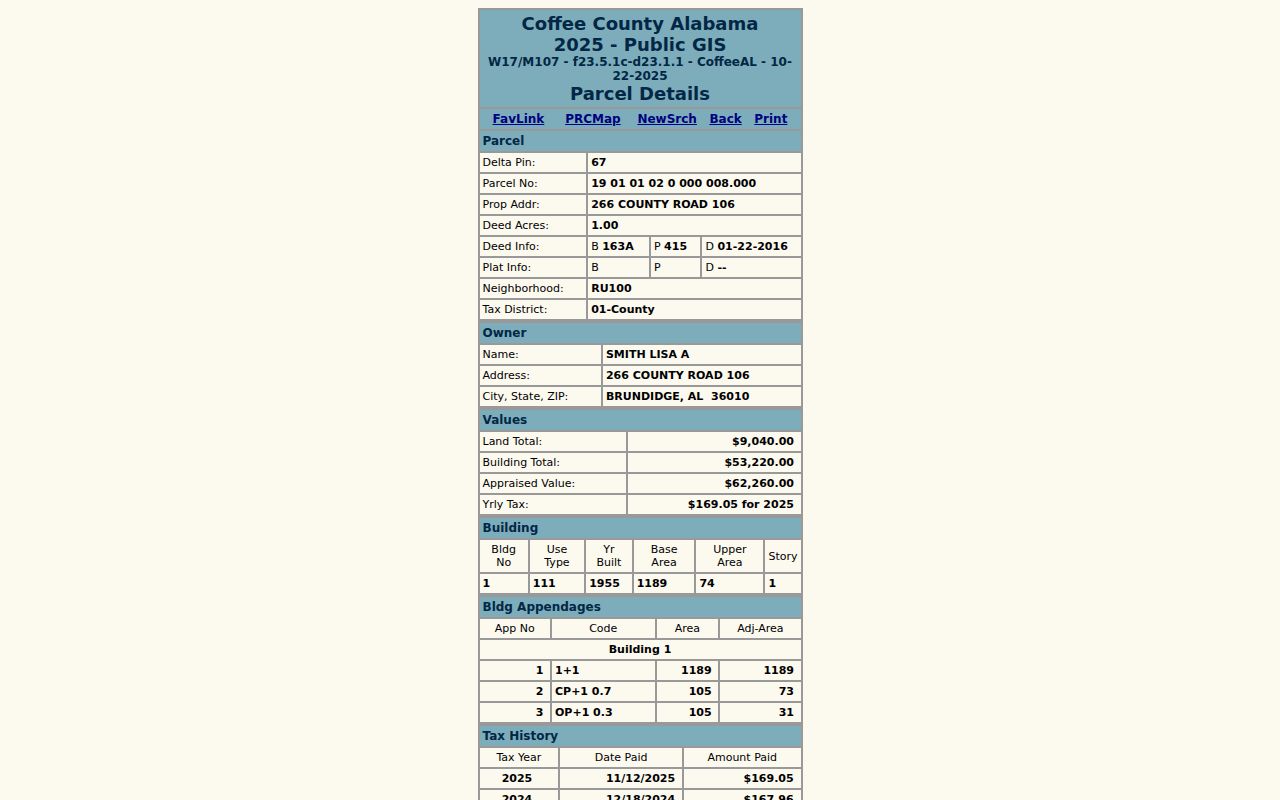
The sample also separates a County Road 106 situs from a Brundidge mailing address. A mailing city does not set the land's tax district or market.
Recorded Sale Value Is a Different Coffee County Fact
Coffee Probate's deed instructions require a Real Estate Sales Validation Form. That form is the RT-1. It accompanies qualifying instruments. Together the deed, validation form, and recording data may supply the transaction's consideration. That number reflects one particular transfer. Family sales, partial interests, and corrective deeds can all weaken it. Non-cash terms can weaken it too. So it may be a weak stand-alone estimate of what the whole parcel would command today.
Keep deed execution, Probate recording, CAMA deed-reference, and assessment-year dates in separate columns. The sample card's deed date and its later tax-history years show the problem plainly. A fifth date may come from a court filing. Never compress those facts into one "value date" or "purchase date."
Why Coffee County Property Values Differ
Timing comes first. A current roll may follow a different effective date from a sale. It may also differ from a private appraisal. Classification comes second, since current-use treatment and exemptions can shift taxable or assessed figures without touching the market evidence for the land. Data scope matters too. The parcel card's improvement information is appraisal evidence, not a permit inspection or construction certificate.
Geography adds its own confusion. Enterprise posts a city millage of 10.5 and a total of 43.5. A CAMA district may point to another county or an abatement context. A tax district is not a City zoning district or a subdivision label. Near Enterprise's urbanizing edges, verify jurisdiction before comparing two parcels. The value fields can be accurate within their own records. Even so, the parcels may not be true peers.
Current Use and Homestead Change the Tax View
Homestead rules and current-use classification change how an Alabama appraisal turns into a tax bill. Neither turns the assessed figure into a sale price. Compare parcels in a fixed order. Record the appraised market value first. Then note classification, exemption, current-use status, assessed value, district, and year. Skip one field and the comparison breaks.
The state's own Alabama property appraisal guidance describes the assessor's appraisal and mapping duties. Coffee County Revenue maintains the local roll. Exemption eligibility, tax bills, and appeals belong in Coffee County property tax records, not the value card alone.
A Tax-Sale Bid Is Not Coffee County Market Value
Alabama's delinquent-property transcripts can list a year, parcel, description, and amount bid. That number answers a delinquency question. It reflects taxes, interest, costs, and redemption rights rather than open-market demand. Calling it a home value misreads the record. The same caution applies before substituting it for appraised value, assessed value, or a deed's stated consideration. That caution covers the assessor's appraisal, the tax roll, and deed records alike.
Label any table before trusting it. Find the custodian first. "Amount bid on a delinquent transcript" is precise wording; "home value" is not. The Alabama Department of Revenue's land-sales and tax-delinquent-property pages explain the Book of Lands. Those pages also explain how redemption works.
What Coffee County Property Value Cannot Tell You
A public assessed value says nothing about current condition, hidden defects, or private contract terms. It will not predict today's offer either. Nor does it settle boundaries, zoning, permits, or title. CAMA's building fields can frame good questions, but City or County permit records and an on-site professional review answer them.
Assessed value is a tax measure. It is not a sale guarantee, private appraisal, or statement of the amount a property would bring on the open market.
Treat a dated CAMA value as one public benchmark. Then add a properly read sale record and, when the stakes justify it, an appraisal prepared for the intended purpose.