
The Coffee County Owner-of-Record Card
The Coffee County parcel card anchors any check of who owns now. It is an administrative snapshot, not a census.
| Current field | What to capture | Why it matters |
|---|---|---|
| Owner | Exact displayed name and capacity | Identifies the present roll entry |
| Parcel and situs | APN and physical address | Anchors the name to land |
| Mailing line | Tax-notice address | May differ from situs or residence |
| Deed reference | Book, page and date | Points to recorded confirmation |
Open the Coffee County CAMA search, save the visible system version, then compare the newest Probate deed by legal description and grantee.
Coffee County Owner Evidence by Source
No single screen settles every piece of ownership. Coffee County spreads appraisal, recording, mapping, entity, and litigation material across separate systems.
| Official source | What it contributes | Access route |
|---|---|---|
| Public GIS/CAMA | Owner display, mailing line, parcel and deed reference | Free web search |
| Judge of Probate | Grantee, grantor, legal description and recording stamp | Free index; paid document pages |
| Flagship GIS | Selected parcel shape and map context | Free viewer |
| Secretary of State | Business entity name and filing context | State business search |
The tax owner is useful and current, but the recorded deed carries more weight. For vesting and transfer, the deed wins.
A Coffee County Parcel Card Is Not an Address Directory
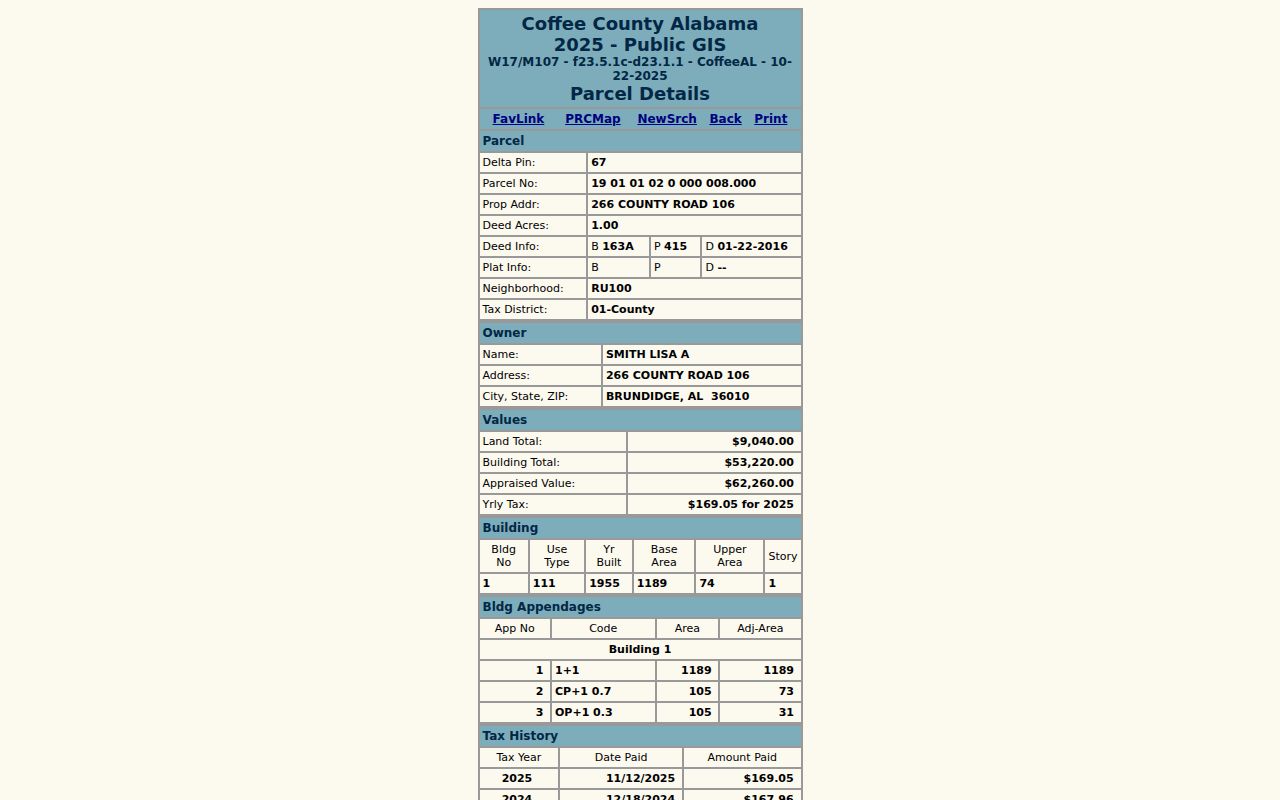
A sample card shows why fields must stay separate. It lists a County Road 106 property address beside a Brundidge mailing address, along with acreage, value, deed data, building details, and tax history. The mailing city proves no residence. Nor does it replace the deed's legal description. The official sample parcel detail shows exactly how these fields appear on a live Coffee County parcel card.
LLCs, Trusts, and Estates in Coffee County Owner Records
When the grantee is an LLC, trust, estate, or representative, copy the deed wording exactly. Phrases like “as trustee,” “personal representative,” “manager,” “successor,” and “nominee” describe legal capacity. Strip them and the record changes. Search Probate first. The Alabama Secretary of State can clarify an entity's name, formation, or status, but its business file does not prove later title or beneficial ownership.
Ownership terms
The owner of record is the recorded name. Vesting states how title is held. A grantee receives the deed interest, while situs marks the parcel location, not necessarily the tax-mailing address.
Keep Coffee County’s Four Property Dates Apart
An ownership search can surface several dates. There is the deed execution date, the Probate recording date, the CAMA deed-reference or roll date, and the assessment year. A lawsuit adds a filing date. These mark different events. Calling one a purchase date can hide a recording delay or a slow roll update, so preserve the source beside each date. The CAMA example shows a deed date and several tax-history years, while the instrument itself supplies its recording stamp.
Note: The inspected interface carried a 2025 Public GIS banner and version date, so later roll changes should be checked.
Why Coffee County Has Two Probate Counters
Geography shapes a Coffee County owner search. Elba holds the primary, older record setting. Enterprise became a second administrative and court center after the 1907 split. A current instrument stays with its recording division. An older chain or cross-division transfer can demand both. Probate lists Elba at 230-P North Court Street and Enterprise at 101 South Edwards Street, with posted hours of Monday through Thursday, 7:00 a.m. to 5:30 p.m.
If the web index does not settle who owns this property, go to the counter. Bring the parcel number, legal description, exact name variants, date range, and book and page. A focused request works better than asking for every record about an address. Name the document you need.
When the Coffee County Web Search Falls Short
Online access is only one channel. The Ingenuity index can be searched without charge, though document viewing and printing carry a per-page charge under the posted Probate instructions. Anyone who cannot locate an image can call or visit the Elba or Enterprise recording counter. Older questions may lead to the FamilySearch catalog. It identifies direct and indirect Coffee County deed indexes, early deed books, and microfilm produced from 1979 through 1989. The Alabama Department of Archives and History adds a research room, catalog, vertical files, and a 1939 WPA township map with owner-list context.
Those archives rebuild leads, not current ownership. They do not answer who owns this property today. Instead, carry an archival name or map reference forward through each later transfer until it meets the newest deed and the current parcel. Coffee County's record losses complicate that work. The 1851 and 1863 courthouse fires, the 1907 division, and the 1929 flood each explain why a historic chain can demand more than one index or preserved copy. One source rarely closes a chain. Label an uncertain link as a lead. Never fill the gap silently.
R.E.A.A.C.T. Monitors a Coffee County Name
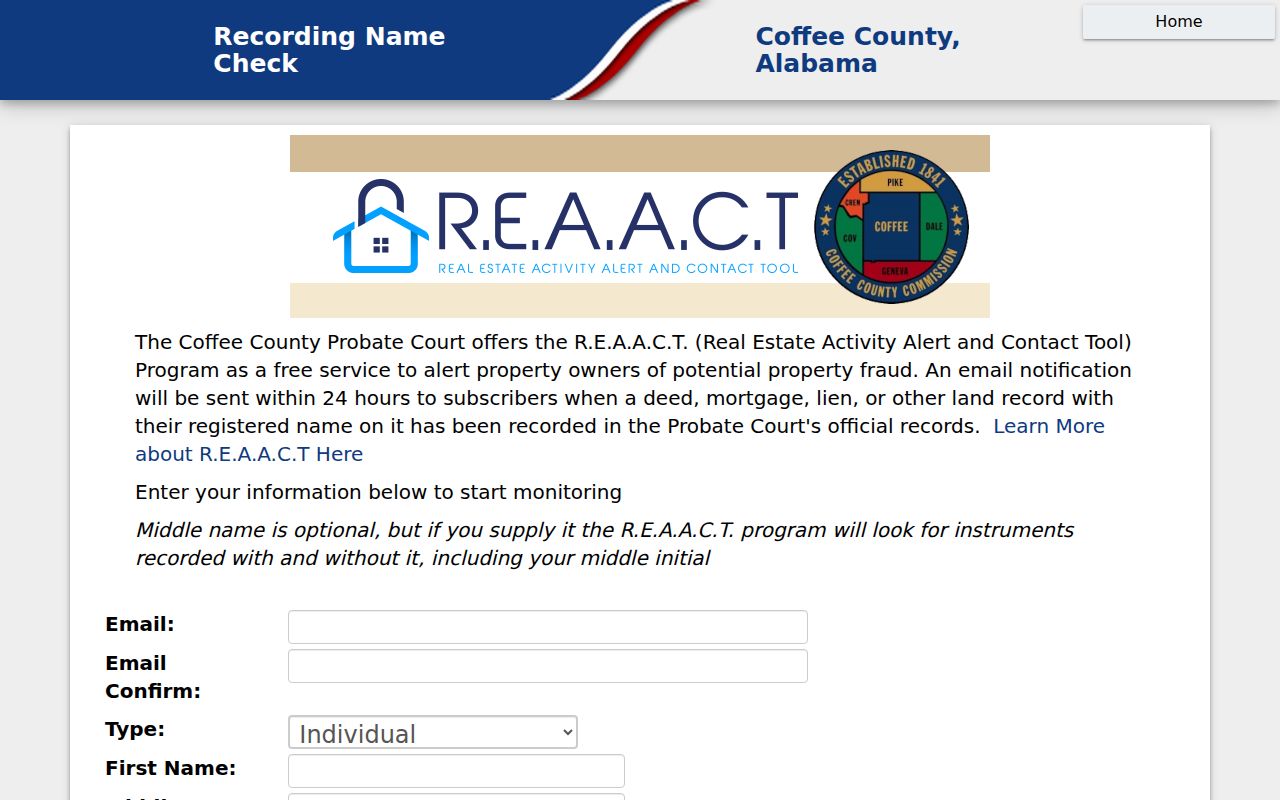
Coffee Probate's R.E.A.A.C.T. service is an after-search safeguard. It registers one exact name with the recording office. Per the office, an email alert follows within 24 hours when that name appears in a newly recorded document. The alert does not stop a filing or decide validity. Register any name variants when prior deeds use more than one form. The official R.E.A.A.C.T. page displays the registration form itself.
Is the Coffee County Current Owner Field Current?
The best recency test compares three things. Line up the card's system version, its deed-reference date, and the newest Probate recording. Start with the parcel number, not the mailing name. Save the current owner exactly as displayed. Keep the situs, district, deed book, and page with it. Then search for any later instrument whose legal description matches the same land. A recent deed often explains the lag. The tax roll's owner of record simply has not caught up yet.
- Capture the owner display, APN, situs, mailing line, and CAMA version.
- Record the deed reference and deed date shown on the card.
- Search exact grantor and grantee styles in the Probate index.
- Compare the legal description, execution date, recording stamp, and grantee.
- Ask the recording counter about a correction, re-recording, missing image, or division prefix.
Anchor every ownership answer to the tax roll version you used. Saying the CAMA current owner appears on a dated roll beats a bare claim of legal ownership. Cite the deed behind it whenever the record card shows one.
Reading a Coffee County Current Owner Record Card
The sample parcel teaches a quick lesson. Its property address and owner mailing address sit in two different places, which proves the two lines serve different jobs. The card also sets a deed reference beside assessed values, building facts, and yearly tax history. Those fields answer separate questions about the same parcel.
Present-owner checkpoint
Identity: the exact displayed name and the capacity shown.
Land key: parcel number, situs address, and legal-description match.
Recorded link: deed book, page, deed date, and recording date.
Freshness: roll version checked against the newest indexed deed.
Four fields, four jobs. The owner field is the tax-roll snapshot. The deed reference points to the transfer, the situs identifies the land, and the mailing line tells Revenue where notices go. A Coffee County result carries the most weight when all four agree, and any mismatch is a reason to verify rather than pick the convenient name.
Current Coffee County Owners Near Enterprise
An Enterprise mailing label does not place land inside the City. Coffee County records show mixed city and unincorporated tracts. These sit near Rucker Boulevard, County Road 17, CR711, Alabama 167, and U.S. 84. Keep the current owner question apart from jurisdiction near those edges. Tax district, zoning label, subdivision name, and city-limit record each answer a different question. Verify the current owner against the deed first. Then ask the City or County Engineer which land-use or address record applies.
The County Engineer assigns addresses for Elba, Kinston, New Brockton, and unincorporated Coffee County. Corporate Enterprise uses a separate contact. A changed address can quietly alter a search key without transferring ownership. When an address result comes up empty, try the old road label, the current situs, the parcel number, and the deed legal description.
Limits of a Coffee County Current Owner Check
Neither the CAMA owner field nor a deed says who occupies the property. Tax mail may go to an owner, an office, or another delivery point. A current owner check also leaves liens, estate issues, boundary disputes, and unrecorded claims unresolved. Circuit Court material sits apart from Probate recording. Many case searches run through Alabama's paid Just One Look service. Tie a court event to the parcel only through shared facts. Use a legal description, instrument reference, party capacity, or a reliable date sequence.
Current does not mean conclusive. Confirm high-stakes ownership with the custodian or a title professional, and never use owner data to harass or target anyone.
For the wider route from a street address to assessor and deed records, see the Coffee County owner-finding method.