
Start a Coffee County Search
The free public CAMA system is a strong starting point. It is also the strongest one for a Coffee County property search. Begin with the narrowest fact you already have. An address works well for one known site. An owner name may turn up several holdings. A parcel number, often called an APN, is the cleanest key once confirmed. Write down the data year, your exact query, and the result count. That way the search can be repeated. The portal displays a '2025 Public GIS' banner. That label matters when a later roll returns a different answer.
- Enter a physical address or owner name in the Coffee CAMA basic search. Begin with few fields so spelling differences do not hide a match.
- Open the likely result. Save its APN, situs address, owner field, deed book and page, district, and displayed roll year.
- Follow the map control to check location and road context. Keep the apparent map line separate from a legal boundary.
- Carry the owner and deed reference to the Coffee Probate index. Search both recording divisions when the history crosses the county's geographic split.
- Check Revenue for current tax status. Order an official copy only after the correct instrument and division are known.
Working in this order builds an audit trail. It also guards against a common mistake: reading the first name on a tax card as final title. A parcel can be easy to find yet still need a newer deed, a recorded plat, or a tax-office update.
Coffee County Search Fields
The detailed Coffee parcel search offers far more controls than the basic form. Query one variable at a time. A parcel-plus-owner request can fail when a trust, estate, company suffix, punctuation mark, or old spelling differs from the roll.
| Portal field | Format or choice | Useful approach |
|---|---|---|
| Pin/account | Optional, up to eight characters | Use only when copied from a county result. |
| Parcel range | Seven segments, with two from/to ranges | Preserve zeroes, spaces, and the final decimal. |
| Owner | Up to 40 characters; begins with or contains | Try surname, then surname and first initial. |
| Physical address | Number and street fields | Test Road, County Road, route, and direction variants. |
| Land and value | Minimum and maximum ranges | Use as a filter, not as identity proof. |
| District/subdivision | Named dropdown choices | Narrow a broad street or owner search. |
| Book, page, date | Detailed parcel mode | Use as a deed lead, then verify in Probate. |
| Result limit | 1,000 through 100,000 | Start low; no public export was verified. |
The system also offers Basic, Parcel, Land, Bldg, and Imp modes. A high result limit does not guarantee a complete bulk download. Note the mode and cap you used.
The official basic form displays a straightforward layout. That layout is helpful when you want a repeatable Coffee County property search.
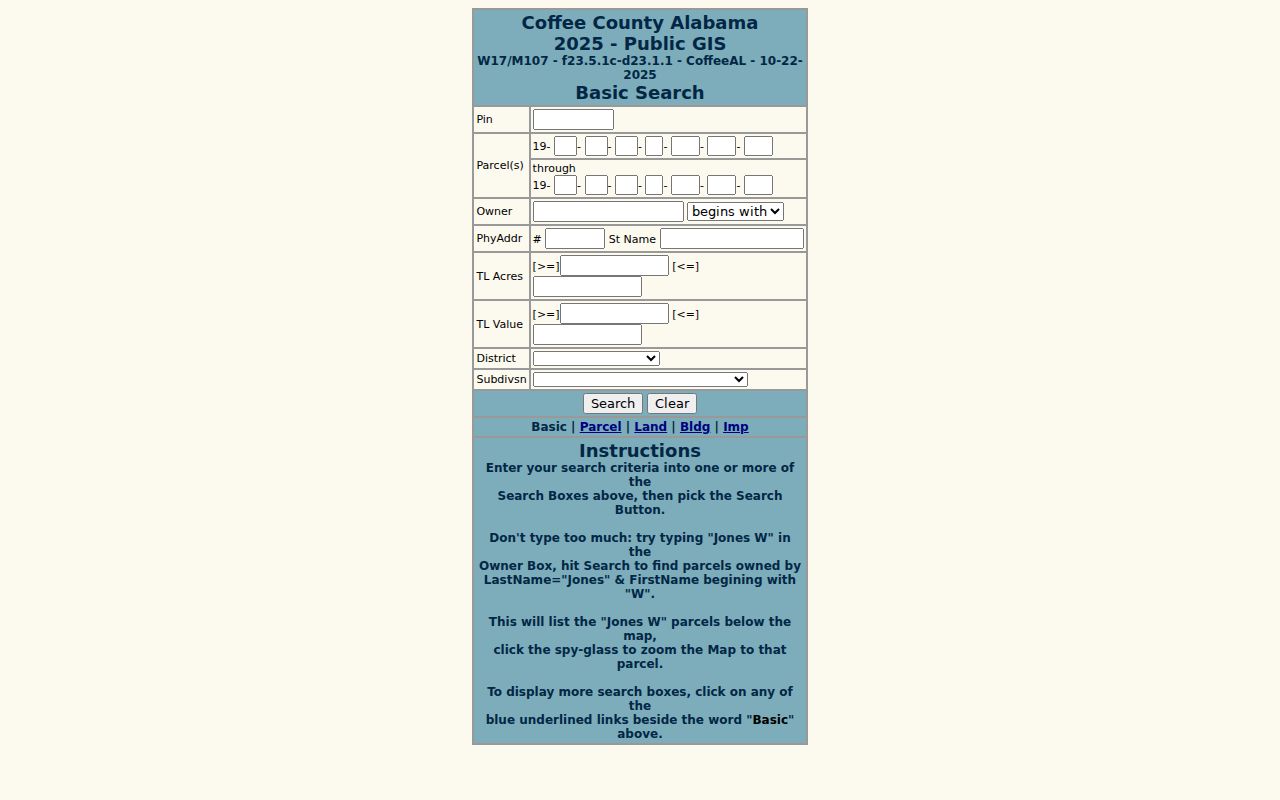
The public entry point shows search fields, not a promise that every parcel or field is current.
Note: Record the portal banner and your search date, because names, values, and parcel links can change with a later roll.
What Coffee County Results Show
A CAMA detail card pulls several useful leads onto one screen. It is a tax and appraisal record. It is not a universal title file. Read each field on its own terms and keep the date attached. The sample card also shows why the situs and mailing lines must never be merged.
| Owner of record | The name used on the current tax roll. |
|---|---|
| Situs and mailing address | The site location and the address used for owner mail, which may differ. |
| Parcel number | The county search key, displayed in seven parts after the 19 prefix. |
| Land, building, appraised value | Separate valuation fields tied to the visible roll. |
| Deed reference | Book, page, and deed date leading to Probate. |
| Building and tax history | Improvement facts plus annual tax and payment entries. |
The sample card lists deed acreage, neighborhood, tax district, and building areas. Its plat fields are blank. A blank does not prove no plat exists. Check the Probate plat index. Check deed attachments and County Engineer subdivision files before drawing that conclusion. The card also carries a deed reference with no separate last-sale-price field. Never relabel a deed date as a sale or invent a price.
The detail view on the public sample parcel card shows appraisal and deed leads sharing one screen.
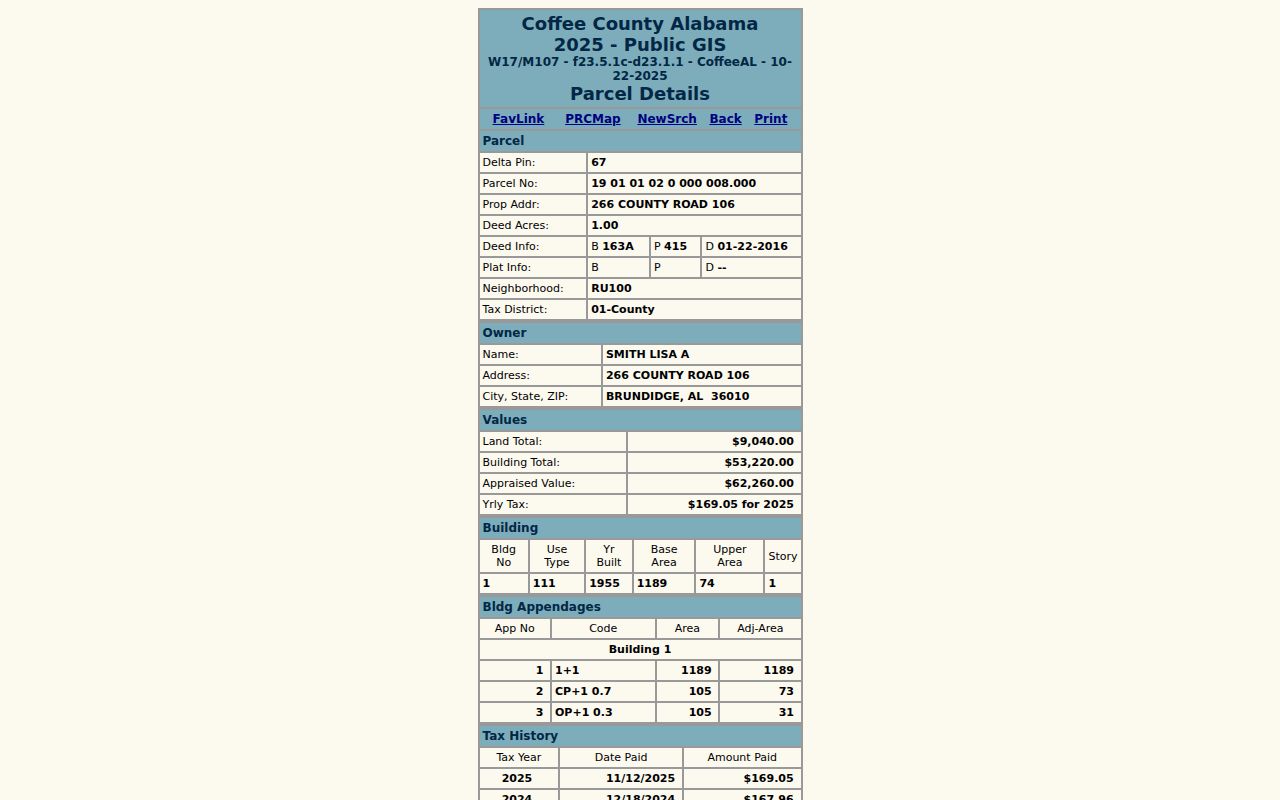
Use the linked deed reference and APN to keep going. The card is a lead, not final proof of title.
Search Coffee County Owner Names
Owner matching defaults to 'begins with.' A query such as Jones W seeks the surname Jones. It also expects a first name starting with W. Start with the surname alone. Then add an initial. Use 'contains' only when the beginning of an entity or trust name is uncertain, since it returns a broader set of results.
Try entity, trustee, estate, and name-order variants when evidence supports them. Too much text can suppress a match. The owner field shows the tax-roll owner. So it reflects present holdings rather than a full chain of past grantees. For recorded ownership history, continue to Coffee County deed records.
Keep the Coffee Parcel Format
Coffee CAMA parcel strings open with county prefix 19 and fill seven component fields. The example appears as 19 01 01 02 0 000 008.000. Input widths run 2, 2, 2, 1, 3, 3, and 3. A decimal appears in the final segment. The separate Pin field accepts up to eight characters.
- Parcel or APN
- The tax-map identifier used to connect county systems; it is not the legal description.
- Situs address
- The physical location assigned to the parcel or improvement.
- Owner of record
- The name carried on a particular official roll, with that roll's timing limits.
- Legal description
- The deed or plat wording that identifies land through lot and block or surveyed calls.
Parcel IDs can be reformatted or replaced after a split or merger. Save the exact display and compare it against deed, plat, and map results. A search key aligns sources but settles no title or boundary question.
Coffee County Address Gaps
Address search in Coffee County uses a short street-number field plus a street-name field. The detailed mode adds mailing-address controls. Try the number by itself. Try the name without its road type, abbreviated and full forms, and direction prefixes. County Road, Highway, and Route variants also help. For a rural tract, widen the net to owner, parcel, subdivision, and section-township-range.
The Coffee County Engineer assigns addresses outside corporate Enterprise, including Elba, Kinston, and New Brockton. A driveway or exact location must come first. So a deed can predate the modern street number. Corporate Enterprise keeps its own addressing contact. Old route labels and municipality lines belong in your evidence, not silently standardized away.
Note: A postal city line can differ from the property's municipal limits. Tax district and physical situs can differ too.
Carry Search Leads to Probate
The Coffee Probate records page points to a free public land and probate search that needs no account. Viewing, downloading, or printing a document costs $2 per page. An account keeps purchased records for 30 days. Before leaving CAMA, save the owner spelling, book/page, deed date, legal description, and parcel.
Coffee County runs Elba and Enterprise recording divisions. Historic completeness may require both. Records center on Elba before the 1907 administrative split, while later eastern and western work may route through different counters. Elba book notation adds an A after the book; Enterprise does not. Pay for only the relevant image. Or ask the correct office for a copy.
The free search runs through the official Ingenuity land-record system, which opens on a plain landing screen.
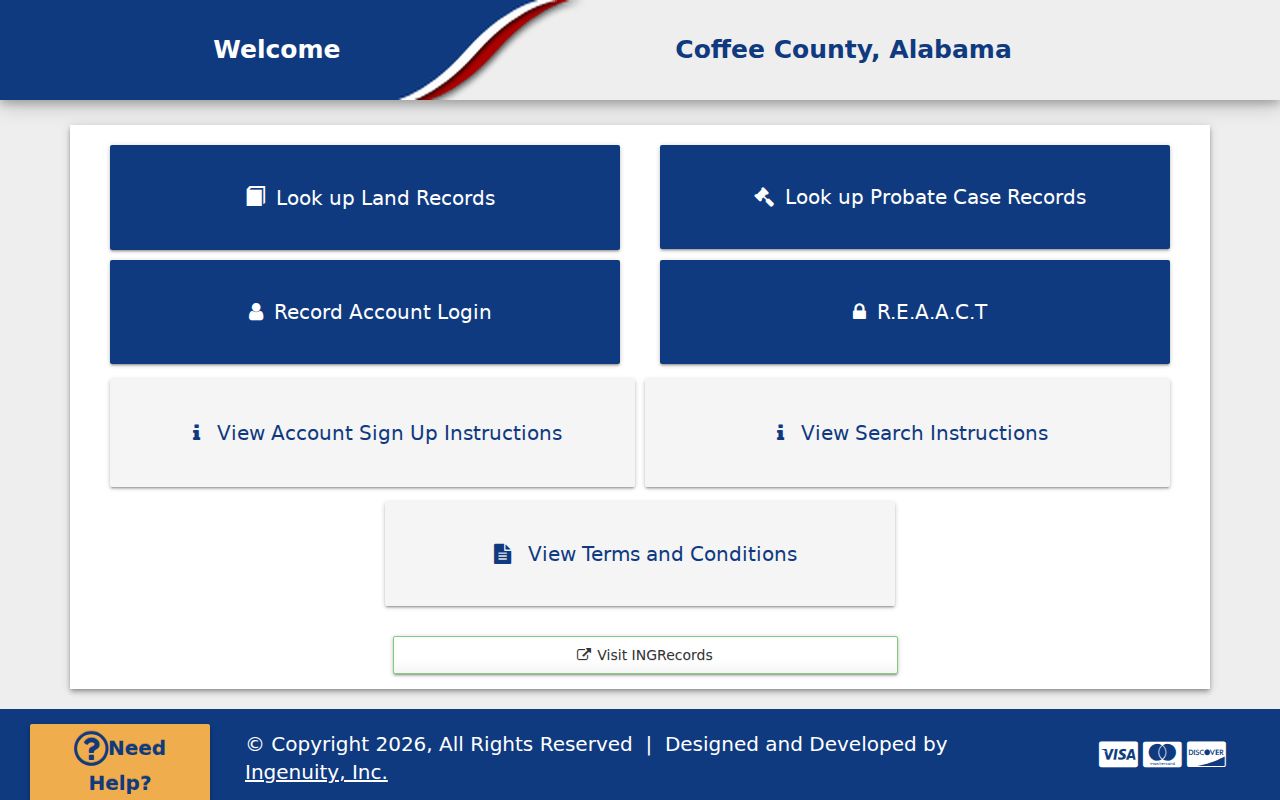
Its access terms distinguish a free index search from paid document retrieval.
When Coffee Records Disagree
Coffee Revenue collects taxes one year in arrears. The tax title ties to the preceding October 1. An “In Care” notice can still carry a prior owner. After a transfer, the buyer records the deed and files a new assessment. Even so, the CAMA owner can lag the newest Probate instrument until the roll updates.
Keep four dates separate. These are deed execution, Probate recording, the CAMA deed-reference or roll date, and the tax year. A court filing may add a fifth. Do not compress them into one purchase date. When names conflict, the newest recorded chain leads on title. Revenue owns tax status, and CAMA owns the displayed appraisal roll.
Log Coffee County Search Results
For every query, log the portal name, visible data version, search date, exact fields entered, result count, chosen record, and any warning. Note whether access was free, whether an account was needed, and whether an image was bought. That small log matters. It separates a true no-result response from a spelling problem, a result cap, a fee wall, or a portal change.
Change one variable at a time. A narrow owner-plus-parcel query can fail even when both records exist, because the roll handles a suffix or punctuation differently. Recording failed searches makes the next attempt faster. It also makes the result more defensible.
The detailed form also allows a deed-date range, instrument book and page, neighborhood, district, subdivision, and section-township-range. Use those controls to narrow a known lead, beginning with a parcel or street fact already supported by a source. A broad subdivision search returns many lots. A deed-date filter may omit the parcel if the appraisal reference has not caught up with Probate. Start with the 1,000-row cap. Increase it only after narrowing, and record the selected limit, since the portal offers no public export control.
When a query returns several candidates, compare APN, physical address, acreage, district, subdivision, and deed reference before opening a card. Similar names mislead. So do repeated rural road numbers. Preserve each rejected candidate in the log with a short reason. The final Coffee County property search then stays reproducible. Personal mailing data stays unpublished too, since the property question never needed it.
Coffee County Search Fallbacks
Online results are only one access channel. Mapping and Appraisal can clarify a parcel key or appraisal field at (334) 894-6066 and (334) 894-6085. Revenue keeps counters in Elba and Enterprise for assessments, exemptions, tax bills, and delinquency. Probate has separate Elba and Enterprise contacts for recorded instruments. Callers should state the APN, record type, relevant year, and book and page if known. Say whether the request is an index check, plain copy, certified copy, or staff research.
Alabama's public-record process is a fallback for records held by the County Commission. Coffee's own form carries special limits, though. It asks for proof of Alabama residency. It also requires in-person delivery to the Commission office at 1065 East McKinnon Street in New Brockton. Never extend it to Probate, Revenue, or court records. Identify the custodian first, then follow that office's own procedure.
Compare Coffee County Search Keys
No single input wins every Coffee County property search. Match the search key to the evidence you hold, then confirm the result with a second identifier.
| Search Key | Best For | Where It Works | Watch Out |
|---|---|---|---|
| Address | One known site | CAMA and GIS | Old roads, new numbers, mailing differences |
| Owner name | Current roll holdings | CAMA and deed index | Trusts, estates, entities, shared names |
| Parcel number | Matching a known county record | CAMA, GIS, and tax work | Splits, mergers, punctuation changes |
| Legal description | Land without a reliable address | Deeds, plats, detailed CAMA fields | Older place names and partial calls |
Not a title search. A Coffee County records search finds official leads but does not guarantee clear title, resolve liens, or replace an attorney or title professional.
Carry the verified APN to the Coffee County parcel maps. The map stays a reference until a recorded description or survey resolves the line.